

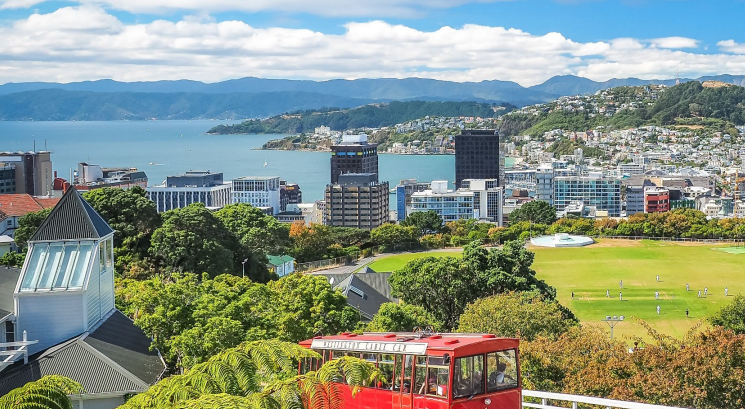
- Low interest rates are expected to drive a rebound in domestic demand, supporting consumption, housing and business investment.
- Export strength and government spending on infrastructure, tourism, and immigration reforms may provide additional tailwinds for growth.
- Election-year uncertainty may delay investment decisions, highlighting the need for bipartisan support to sustain New Zealand's long-term growth.
Introduction
History has taught us that forecasting can be a humbling business. Yet the annual end-of-year ritual of looking both back and forward remains a valuable exercise—not necessarily for predicting the future with absolute precision, but for learning from history and framing the forces most likely to shape what lies ahead.
This time in 2024, after a tough year my New Zealand Fixed Income colleague Ian Bellew found himself presciently considering a reasonably grim economic outlook for 2025, with his glass very much half empty. While the outlook for global markets remains more nuanced, the long dark cloud that has hovered above New Zealand’s economy seems finally to be shifting, providing room for some overdue optimism around our economic prospects.
Rate settings to restart growth
Interest rates remain the single most effective tool to deliver an economic recovery - and that tool has been progressively sharpened in 2025. Following a (possibly final) OCR cut at the end of November 2025, rates are expected to stay at cyclical lows through 2026, meaning that conditions are in place for a meaningful rebound in domestic demand.
Lower borrowing costs should support consumption, business investment and a recovery in housing activity – which has historically been a cornerstone of New Zealand’s economic cycles. However, rates are unlikely to stay at their cyclical low for too long and as growth returns, markets will begin pricing in the prospect of hikes, potentially even before the end of 2026, with clear implications for New Zealanders.
- Borrowers may want to secure longer-term funding early in the year to lock in favourable conditions.
- Fixed income investors should consider gradually reducing duration as upward pressure on yields re-emerges.
- The equity market may see a rotation out of rate-sensitive assets, such as commercial property, towards cyclicals leveraged to stronger domestic demand, such as building materials, tourism and retail.
A word too, on our dollar. Just like our economy, this has been a global underperformer over the last few years. A reversal of domestic economic fortune though should be mirrored by rebounding currency strength, therefore investors in global markets should begin to consider increasing the hedging of foreign assets to the NZD as the trend towards a lower NZ Dollar starts to reverse.
Supporting tailwinds: exports, investment and policy
Beyond lower interest rates, there are other influential forces at play that can help establish and build on domestic momentum.
Export incomes remain elevated, providing valuable liquidity to the wider economy. Sentiment in agriculture – our most globally competitive sector – has improved significantly to the point that commentators this year labelled our economy “two speed”, with the pace to be found in rural New Zealand.
And after helping to depress consumer optimism by reigning in their spending, the Coalition Government is now trying to turn the ship around by bringing forward maintenance and build expenditure on education and health infrastructure. More flexibility in immigration settings and tweaks to help the international student industry will also be growth friendly, so too the greater focus on tourism and encouraging major events to this country.
Together, these drivers should support a more vibrant, dynamic economic environment in New Zealand over 2026 and 2027.
The three-year curse waiting to strike
However, having shifted one dark cloud, another will loom as we head towards the end of the year in the shape of a general election.
When we analyse why New Zealand’s investment and therefore growth cycles are not as sustained as many other nations’ —and why we are all the poorer for it—our three-yearly electoral cycle of uncertainties looms large as a contributing reason. Given the divergent views on policy focus between all parties, even those within the coalition, the only thing we can say with certainty about the election this year is that it will see delays in or possibly postponement of investment and spending intentions until the make-up of the next government is known.
If we do not extend the parliamentary term to create more planning certainty, then bi-partisan support among the major political players should be an even higher priority in areas crucial to New Zealand’s prosperity.
Planning further ahead
Before we get too carried away by our near-term prospects, it’s worth considering our current long-term fiscal trajectory.
Today, Net Crown Debt sits at roughly 43% of GDP, with annual servicing costs around New Zealand dollar 9 billion. This is money that is going into the pockets of New Zealand’s financiers, rather than to doctors, nurses, teachers et al.
Under current settings, Treasury projections show debt potentially rising towards 200% of GDP over the long term, for which the cost of servicing would be crippling. The good news is that all New Zealanders have the opportunity to contribute to efforts to prevent us from ending up here by growing individual and thereby collective wealth. The even better news is that it may not be as difficult as it sounds:
- Shift from saving to investing
Households and businesses should prioritise productive investment over low-yield savings. For many, this may include migrating to higher-growth KiwiSaver options.
- Human capital and innovation
Upskilling, AI adoption, and technology commercialisation present global-scale opportunities. The success of firms like Rocket Lab and Zuru demonstrates that breakthrough innovation can originate from New Zealand.
- Agricultural productivity
Expanding irrigation, upgrading processing capacity and accelerating value-added food exports – essentially playing to our strengths – can deliver both employment and export growth.
A final word
New Zealand enters 2026 with more favourable tailwinds than we have felt for some time, with stronger export conditions and meaningful policy support. Moreover, our economic destiny is very much back in our own hands, meaning that half-empty glass we were clutching last year appears to have been replaced by one that now seems at least half-full.