


Snapshot
Markets showed continued resilience in the early part of the July–September quarter, with European equities starting the quarter broadly higher and the MSCI All Country World Index rising in US dollar (USD) terms. On the fixed income side, US Treasury (UST) yields rebounded early in the quarter, but super-long Japanese government bonds (JGBs) experienced weakness that spilled over to longer-dated USTs. Global equities showed positive momentum in the mid-part of the quarter, with the S&P 500 Index rising, the Chinese market moving higher and the MSCI All Country World Index advancing in USD terms. UST yields dropped sharply towards the quarter’s middle, but they soon rebounded. Global equities surged in the latter part of the quarter, with the S&P 500 Index and the Stoxx Europe 600 both gaining in the month of September. In Asia, Taiwan and South Korea’s tech-heavy markets led gains while Chinese tech stocks also rallied towards the end of the quarter. In fixed income, UST 2-year and 10-year yields both ended the quarter slightly lower than at the end of August.
Outside of equity and fixed income markets, crude oil prices (as measured by West Texas Intermediate crude oil) climbed while gold prices and real estate (as measured by the FTSE NAREIT Global Real Estate Index) both edged downward early in the quarter. The middle of the quarter was marked by a surge in gold prices, a drop in crude oil prices and gains in real estate. Towards the quarter’s close, gold prices soared, crude oil prices declined and real estate edged upward.
Early in the quarter, risk assets were lifted mainly by progress in trade negotiations between the US and several of its trading partners, the return of the artificial intelligence (AI) theme and a
strong start to the US earnings season. Strength in UST yields early in the quarter was chiefly driven by tariff negotiation developments and shifting expectations for US interest rates, while
fiscal concerns in Japan put pressure on super-long JGBs. Also early in the quarter, crude oil prices were pushed upward partly by US President Donald Trump’s threat of secondary sanctions on
countries buying Russian oil, while news of trade deals weighed gold prices down by sapping safe-haven demand. In the mid-part of the quarter, optimism around a potential September interest rate cut
by the US Federal Reserve (Fed) boosted investor sentiment, while Chinese equities were pushed upward by factors including expectations for policy support. Rate cut expectations also lifted gold
prices and real estate in the mid-part of the quarter, while UST yields rebounded on strong inflation figures after dropping in response to weak employment data. Oil prices dropped in the middle of
the quarter amid concern for a potential continued supply glut. Towards the quarter’s end, equities surged in response to the Fed’s first rate cut of the year and guidance for two more
cuts by the year’s end. Risk-on sentiment was also boosted by AI-related news. Chinese stocks benefitted late in the quarter from continued expectations of policy support and easing US-China
trade tensions. UST yields were weighed down by weak US employment figures but subsequently lifted by stronger domestic data towards the quarter’s end. The surge in gold prices towards the end
of the quarter was driven by safe-haven demand amid concerns such as US government shutdown risks, while crude oil was impacted by oversupply fears and real estate benefited from modest gains in
property markets.
Cross-asset 1
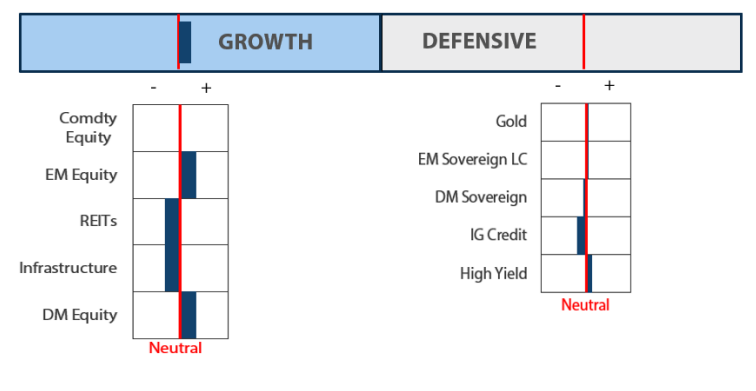
For the July–September quarter, we maintained an overweight position in growth assets and kept defensives neutral.
Our overweight in growth assets reflected continued optimism around global growth and supportive monetary policy, though we trimmed active positions early in the quarter amid historically weak seasonality and elevated valuations. US equities remained resilient, supported by strong earnings surprises and expectations of Fed rate cuts, while mega-cap technology names continued to dominate performance. We kept our overweight in US equities and maintained a neutral stance on Europe. Japan was downgraded to underweight on expectations of yen strength following election results and a more hawkish Bank of Japan stance, though the country’s long-term structural story remains intact. We continued to favour Canada and Singapore for their exposure to financials and attractive dividend yields.
In emerging markets (EM), we increased our overweight as dollar weakness and falling policy rates provided a tailwind. India remained in our favour given its structural growth story, while Taiwan continued to benefit from the global tech upcycle. We maintained underweights in REITs and infrastructure in view of better risk-reward profiles elsewhere.
On defensive assets, we remained neutral overall, balancing the positives from the Fed’s rate-cutting cycle against tight credit spreads. We maintained a slight underweight in DM sovereigns, as valuations remain expensive and curves have not steepened enough to make long-end bonds attractive. We increased EM sovereigns from underweight to a small overweight amid dollar weakness and improving fiscal dynamics. Gold allocations were increased late in the quarter to a slight overweight, as the commodity regained appeal as a hedge amid policy uncertainty and rising geopolitical risks.
1 The Multi Asset team’s cross-asset views are expressed at three different levels: (1) growth versus defensive, (2) cross asset within growth and defensive assets, and (3) relative asset views within each asset class. These levels describe our research and intuition that asset classes behave similarly or disparately in predictable ways, such that cross-asset scoring makes sense and ultimately leads to more deliberate and robust portfolio construction.
Asset Class Hierarchy (Team View) 2
2
The asset classes or sectors mentioned herein are a reflection of the portfolio manager’s current view of the investment strategies taken on behalf of the portfolio managed. The research
framework is divided into 3 levels of analysis. The scores presented reflect the team’s view of each asset relative to others in its asset class as at 30 June 2025. Scores within each asset
class will average to neutral, with the exception of Commodity. These comments should not be constituted as an investment research or recommendation advice. Any prediction, projection or forecast on
sectors, the economy and/or the market trends is not necessarily indicative of their future state or likely performances.
Research views
Growth assets: summary of score changes in Q3
Growth assets remain attractive, supported by resilient global economic conditions and an upward trajectory in earnings growth. Despite persistent uncertainties surrounding US import tariffs and
their legal challenges, market sentiment improved with more trade deals being completed and equity indices globally reaching new highs. Investors interpreted softer US economic data as a signal for
monetary easing, and the start of the Fed’s rate-cutting cycle reinforced a risk-on environment. Inflation remained benign worldwide, giving central banks room to implement supportive measures
to bolster growth.
Overall, earnings growth remains on an upward trajectory, providing support for growth assets. The upcoming earnings season was expected to clarify the impact of tariffs as companies worked through inventories accumulated before “Liberation Day” and began restocking. With market expectations largely unchanged since then, the low bar for corporate results set the stage for potential earnings beats. Investors will be fixated on the US labour data in the coming months as they look for clues on the Fed’s policy stance. In the short term, the passing of the US tax bill is positive and could help boost consumption and corporate profits, while anticipated Fed rate cuts in the coming months may further support continued economic activity in the US.
Conviction views on growth assets
Overweight exposure to US growth maintained for now : We continue to like the US for its secular long-term earnings growth driven by technology and healthcare innovations. We are also positive on increasing energy demand from data centres with the significant AI capex outlay over the next few years. There remains potential for positive surprises in the market, such as responses from central banks and relief from import tariffs.
Overweight on Singapore and Canada : We still have an overweight position in Singapore due to its defensive attributes. Singapore offers high dividend yields and low beta. The market is also strong in terms of relative valuation metrics and is least likely to be targeted by Trump’s tariff policies, given Singapore’s trade balance deficit. We also like Canada for its heavier exposure to financials, energy and materials sectors which will provide good diversification from technology.
Increased our overweight exposure to EMs : Within EM, we prefer selective markets, such as India, which benefit from domestically driven economies and structural long-term growth stories. We also like Taiwan for its exposure to the technology sector, as it is a key supplier of semiconductors for the secular growth trend of AI capex rollout. A weaker dollar would be tailwinds for the region as central banks are able to cut rates to support economic activity.
Neutral on commodity-linked equities : We continue to believe that commodity-linked equities will continue providing good diversification against inflation in the longer term. The fundamentals of the sector remain compelling due to both cyclical and secular factors.
Growth assets topic: prelude to Q3 earnings season
After a strong second quarter (Q2) earnings season which saw many corporates beat the top and bottom lines whilst giving better-than-expected guidance for the year, many investors are looking for clues on whether the same stellar performance could be sustained into the third quarter (Q3). Since the start of the year, earnings have been revised lower through time and especially closer to “Liberation Day” on 2 April when President Trump announced his trade tariffs. Markets were spooked by the massive import tariffs as fears of inflation coupled with slower growth as a result led to renewed calls for global recession. The earnings growth of both Q2 and Q3 cratered since then, reaching its low in May. Trump has since dialled back the magnitude of tariffs as trade deals are being struck and corporates showed that they were able to weather the increases in import tariffs better than expected.
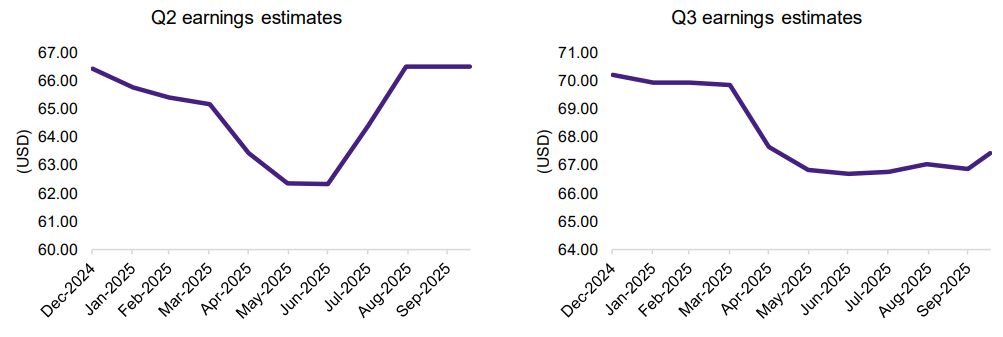
Q2 earnings estimates for S&P 500 firms were revised higher through the reporting season, with revised estimates eventually reaching levels not seen since the start of the year. On the other hand, it is interesting that Q3 earnings growth estimates are still lingering near lows seen in May and are yet to be adjusted higher despite a good Q2 reporting season (See Chart 1). What this implies is that analysts have been slow to revise their estimates, setting a low bar to beat in the current Q3 earnings season.
Chart 1: Low bar to beat for S&P 500 firms
Source: Fact S et, October 2025
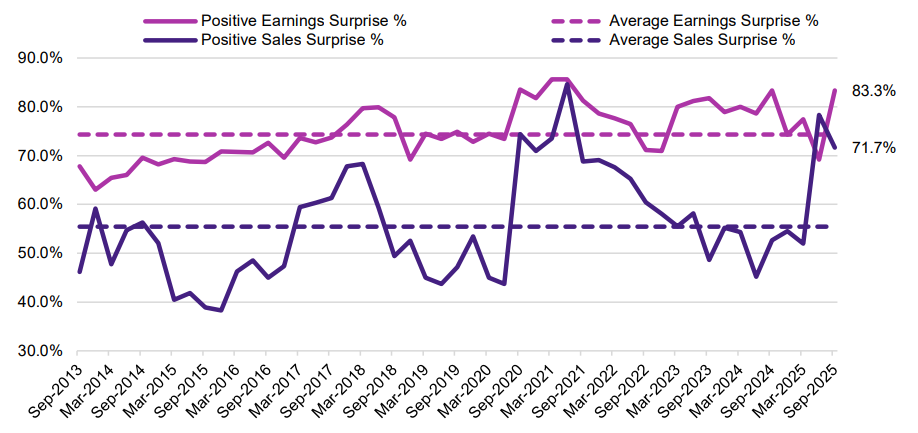
As we kicked off the Q3 earnings season, more than 10% of the S&P 500 companies have reported their earnings so far with firms in the financial sector leading the charge. As expected, results are turning out to be very strong with 83% of these companies surpassing market expectations, exceeding the historical average beat rate of 74% (See Chart 2). This quarter’s results were encouraging, with 72% of companies beating sales estimates—one of the best quarters in years compared to the historical average of 55%. We attribute this strong performance to a weaker dollar, which provided a tailwind for companies with overseas revenue, similar to what we saw in Q2. As we move through the quarter, we expect companies with a higher percentage of overseas revenue, such as those in the technology and communications sectors, to benefit from a weaker dollar.
Chart 2: S&P 500 companies’ earnings are off with a bang
Source: Bloomberg, October 2025
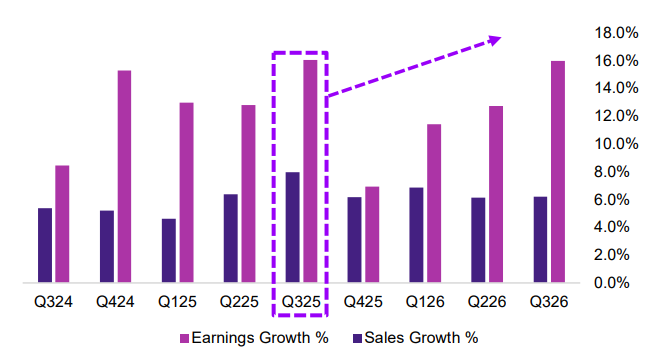
The quality of the earnings surprise was notably strong, with the magnitude of beats averaging almost 16% year-over-year (YoY)—well above the pre-earnings season average of 8% YoY. Likewise, sales outperformance was impressive, coming in at 6% YoY, the highest in the past three years and in line with consensus estimates. A key positive was the continued expansion in corporate margins, which signals a healthy corporate environment. We believe that operating margins are a leading indicator for corporate earnings health and any downturn in margins typically portends a labour market downturn which can trigger economic slowdowns. Corporate guidance was also largely positive with many firms, particularly banks, reporting increased activity. This is supportive of further economic expansion, despite fears of potential tariff impacts.
Chart 3: Earnings and sales growth best in quarters
Source: Bloomberg, October 2025
Defensive assets: summary of score changes in Q2
Defensive assets showed a mixed performance during the quarter. Global bond markets were soft at the start of the quarter, weighed by rising yields due to concerns on sticky inflation caused by import tariffs. The Fed initially held rates steady, with Chair Jerome Powell adopting a cautious tone, stating that restrictive monetary policy was yet to show signs of slowing growth and that the uncertain inflationary impact of tariffs needed careful monitoring. However, subsequent weakness in US non-farm payrolls data shifted expectations towards further easing given the Fed’s dual mandate of ensuring price stability and stable labour market.
As the quarter progressed, markets started to price in lower rate expectations and lower-than-expected inflation supported defensive assets. In the September FOMC meeting, the Fed cut the interest rate given the weak labour conditions and guided for more rate cuts in the coming months which saw the defensive assets rallying. Gold was again a standout performer, rising nearly 12% for the month and over 48% year-to-date in USD terms. Overall, the combination of anticipated Fed rate cuts, a weaker dollar, rising deficits and sticky inflation reinforced positive sentiment towards gold, even as technicals appeared stretched in the near term. Meanwhile, Japan saw a surprise leadership change in the ruling Liberal Democratic Party (LDP), influencing the outlook for Japanese assets in the near term.
Conviction views on defensive assets
Underweight exposure to IG credit spreads : Credit spreads have performed well over the past three months, hitting levels not seen since the mid-2000s. While we cannot foresee what will shift spreads wider in the near term, the fact that spreads are a mean-reverting series means that we continue to maintain our underweight position in the asset class. We prefer to keep exposures short, in the 1–5 year maturities to limit spread duration.
Gold expensive but necessary : With prices rising for over a year now, gold has reached high valuations versus the US money supply. Despite this, we are growing more positive on the asset class once again as the macro backdrop involving expectations of weaker dollar, pervasive inflation, and the Fed’s independence at risk give rise to gold potentially serving as a strong hedge compared to sovereign bonds.
Overweight duration in selective countries : While we expect the trade deals to be less impactful than the market expectations, central banks do not have this luxury. With the risk of growth slowing, a number of central banks should continue easing, including the Bank of England, Reserve Bank of Australia and the Fed. We like to use Australia as our overweight in duration as among the developed markets it has the largest link to China, and while trade deals could materialise for US allies, China will likely be singled out and face higher tariffs.
Defensive assets topic: a new leader for the ruling LDP in Japan
In a result that surprised markets, early in October the Japanese ruling LDP elected Sanae Takaichi as party leader, overcoming betting markets’ favourite Shinjiro Koizumi. Following the result, Japanese risk markets moved broadly, with the Nikkei jumping some 2.9%, the yen selling off almost 2.9%, and 30-year Japanese Government Bonds (JGB) yield rising about 14 basis points in the trading session that followed. These drastic moves reflect the more expansionary views of Takaichi (chosen as prime minister late in October following a parliamentary vote), who has been critical of the Bank of Japan (BOJ) moving rates higher and previously called for income tax cuts. Given Japan’s high levels of government debt, persistent deficit and currently higher-than-average inflation, the timing does not appear ideal to push expansionary policy; we will likely see additional pressure mount on the long end of the JGB curve if this policy set progresses unopposed. Interestingly, as Chart 4 below shows, while the JGB market performed stronger in 2022, the sell-off has since merged into a death by a thousand cuts as an overly easy policy has morphed into prolonged rises in yield which now appear set to continue.
Chart 4: JGB performance vs USTs
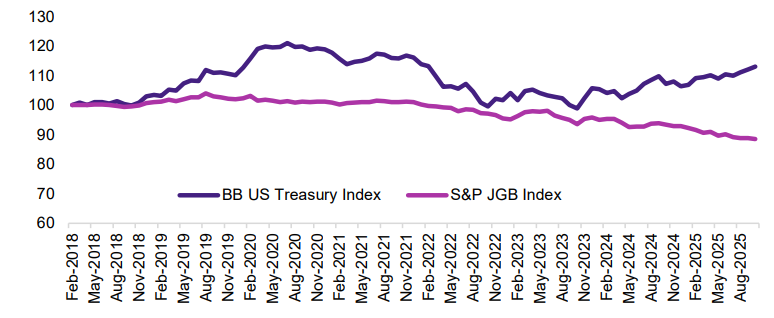
Rebased to 100 on February 2018
Source: Bloomberg, Amova Asset Management , October 2025
The victory has also appeared to spill over into other asset classes, with gold in Japanese yen (JPY) terms performing particularly strongly. Currently, the market is extremely focused on the “debasement trade”, whereby hard assets such as gold are being held in place of government bonds to provide protection against prolific government spending and currency debasement. This appears to be particularly the case when expressed in JPY terms; Chart 5 below shows gold increasing roughly two-fold over the past three years against the yen, outperforming the debasement trade that has occurred in USD terms. We continue to look for signs whether the market is questioning the solvency of governments globally.
Chart 5: Gold prices in JPY and USD
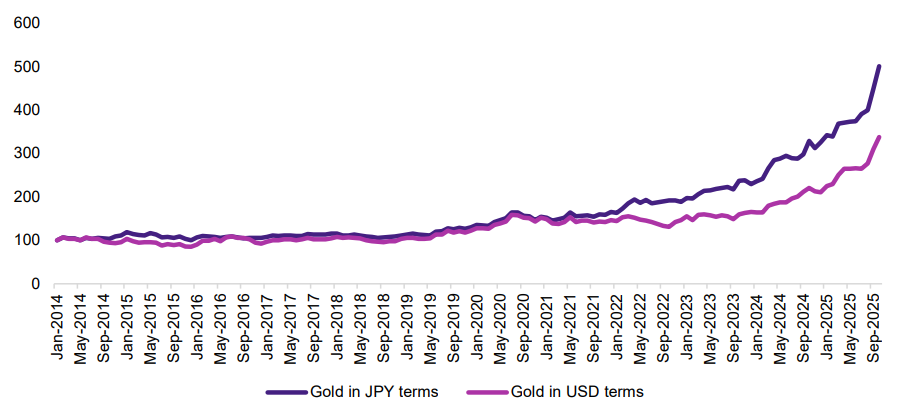
Rebased to 100 on January 2014
Source: Bloomberg, Amova AM , October 2025
On the Japanese asset side, while Takaichi’s policy stance has been viewed as expansionary, some indigestion could occur politically as junior coalition partner Komeito left the ruling party bloc, forcing the LDP to form a new coalition with Nippon Ishin (Japan Innovation Party). Nippon Ishin favours relatively expansionary policy, leading markets to expect equities to continue grinding higher. However, the coalition will not quite have the numbers to form a majority, making continued political turmoil likely over the short-term. Similar to political outcomes in other countries, the tough fiscal position and debt overhang have made it extremely difficult for Japanese politicians to govern, and the constant rotation of prime ministers signals more deadlock is ahead. We have begun favouring JGBs again despite the uncertain fiscal outlook, although we prefer to keep our duration profile controlled, focusing on a 3–5 year maturity range, where the income may overcome any capital changes. We also continue to view gold as a hedge against poor fiscal management, and despite the debasement narrative, we still see bonds playing a role in portfolio construction—as the can of poor government finances is likely to be kicked down the road once again.