


Rising inflation, fiscal concerns and the normalisation of monetary policy have pushed Japanese government bond (JGB) yields sharply higher from rock-bottom levels, ushering in a new phase for the bond market. As yields rise, there are signs that domestic institutional investors are being drawn back into the Japanese bond market. Higher yields may also entice more foreign investors into JGBs. These sources of demand could help stabilise the bond market when a number of factors continue to exert upward pressure on yields.
Recovering domestic investor demand for JGBs
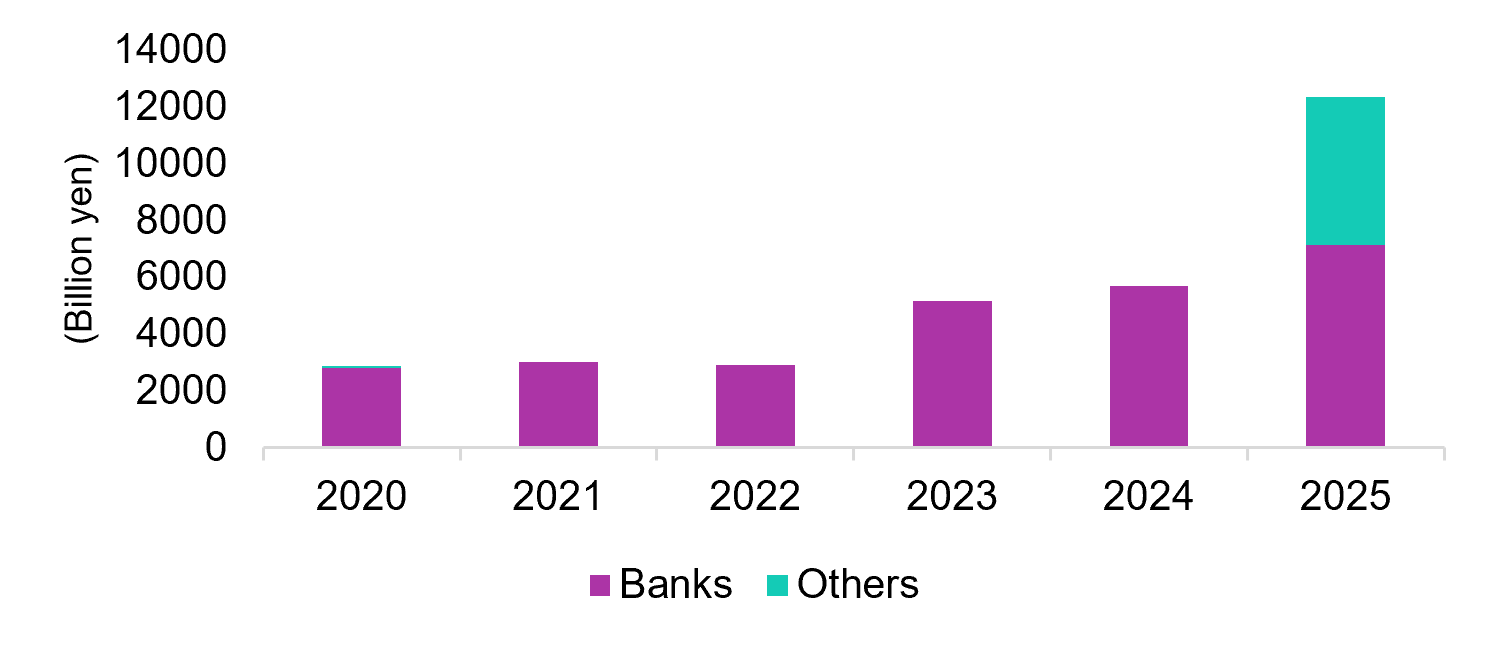
Historically, domestic banks have been core buyers of JGBs. However, during the Bank of Japan (BOJ)’s zero and negative interest rate phase, which lasted through March 2024, their interest in JGBs appeared to have ebbed somewhat, with the benchmark 10-year JGB yield briefly slipping below zero percent. Even so, yields have risen since the BOJ began normalising policy, and banks are becoming active buyers of JGBs again. Banks have been observed stepping into the JGB market as the 10-year yield approached 1% in 2024, 2% in 2025 and 3% in 2026. In 2025, direct bids at the Ministry of Finance’s JGB auctions reached approximately Japanese yen (JPY) 12 trillion, with banks estimated to account for around 60% of that total. Estimates based on investor transaction data and other available information suggest that demand from end-investors such as banks has been stronger so far in 2026 than in 2025, indicating that institutional interest remains robust.
Chart 1: Direct bids for long-end JGBs at MOF auctions
Source: Ministry of Finance (MOF)
Japanese insurers, which are traditional buyers of super-long JGBs, are showing similar interest. In 2025 and 2026, according to media reports, institutions including Asahi Life, Meiji Yasuda Life and Fukoku Life described domestic yields as attractive or outlined plans to increase JGB holdings. Asahi Life, for example, reportedly said attractive domestic yields prompted a shift by the insurer from foreign to domestic bonds.
Higher yields thus appear to be attracting buyers, potentially stabilising the JGB market, which has experienced bouts of volatility. That said, it is worth noting that previous assessments of attractive yield levels have proved premature. Investors previously described the 10-year yield at the 2–2.5% level as “attractive” and “fair value”, but the yield went on to rise towards 3%. Fundamentals—rather than any particular investor-defined threshold—thus remain crucial to the outlook.
Japanese appetite for foreign bonds remains relatively subdued
The domestic story becomes more interesting when considered alongside Japanese institutions’ overseas investment.
Japanese investors have traditionally been active participants in global bond markets, particularly during the long period in which domestic yields offered little income. Amid the rise in domestic yields, however, recent flows into overseas bonds are relatively subdued.
According to data from the Japan Securities Dealers Association (JSDA), Japanese investors made net purchases of approximately JPY 2.8 trillion of long-term foreign bonds in FY2024. This was well below the 10-year average of JPY 7.1 trillion. Net purchases remained at approximately JPY 2.8 trillion in FY2025, while purchases totalled approximately JPY 2.4 trillion during the first half of FY2026.
Shorter-term data also reveal considerable volatility in these flows. Japanese investors purchased a net JPY 3.1 trillion of long-term foreign bonds in May 2026, when 10-year US Treasury yields were around 4.3–4.7%. But by September 2026, when 10-year US Treasury yields were around 4.8–5.2%, they sold approximately JPY 1.4 trillion on a net basis.
The figures are noteworthy because they suggest a moderation in demand for foreign bonds. Japanese institutions are still buyers of foreign bonds, but at relatively lower levels.
Is the relative appeal of JGBs changing?
For many years, Japan’s exceptionally low interest rates provided a strong incentive for domestic financial institutions to look outside the country for yield. However, rising domestic yields are eroding the advantage that foreign bonds once offered over JGBs.
For a Japanese investor, the relevant comparison is not simply between the nominal yield on a JGB and the yield on a foreign bond. Foreign bonds introduce currency exposure or, if that exposure is hedged, the cost of hedging it. Institutions must also consider volatility, duration, capital requirements and asset-liability matching. As their yields rise, JGBs can therefore become competitive without necessarily offering the highest headline yield.
There are signs that this is already influencing investment decisions at some institutions. As mentioned above, a number of Japanese institutional investors such as life insurers have indicated an intention to shift from foreign bonds toward yen bonds. Nevertheless, it would be premature to conclude that Japanese financial institutions as a whole are undertaking a large-scale repatriation from overseas bonds.
Could foreign investors become an additional source of demand?
In addition to domestic institutions, foreign investors are key participants in the JGB market, particularly in the super-longs.
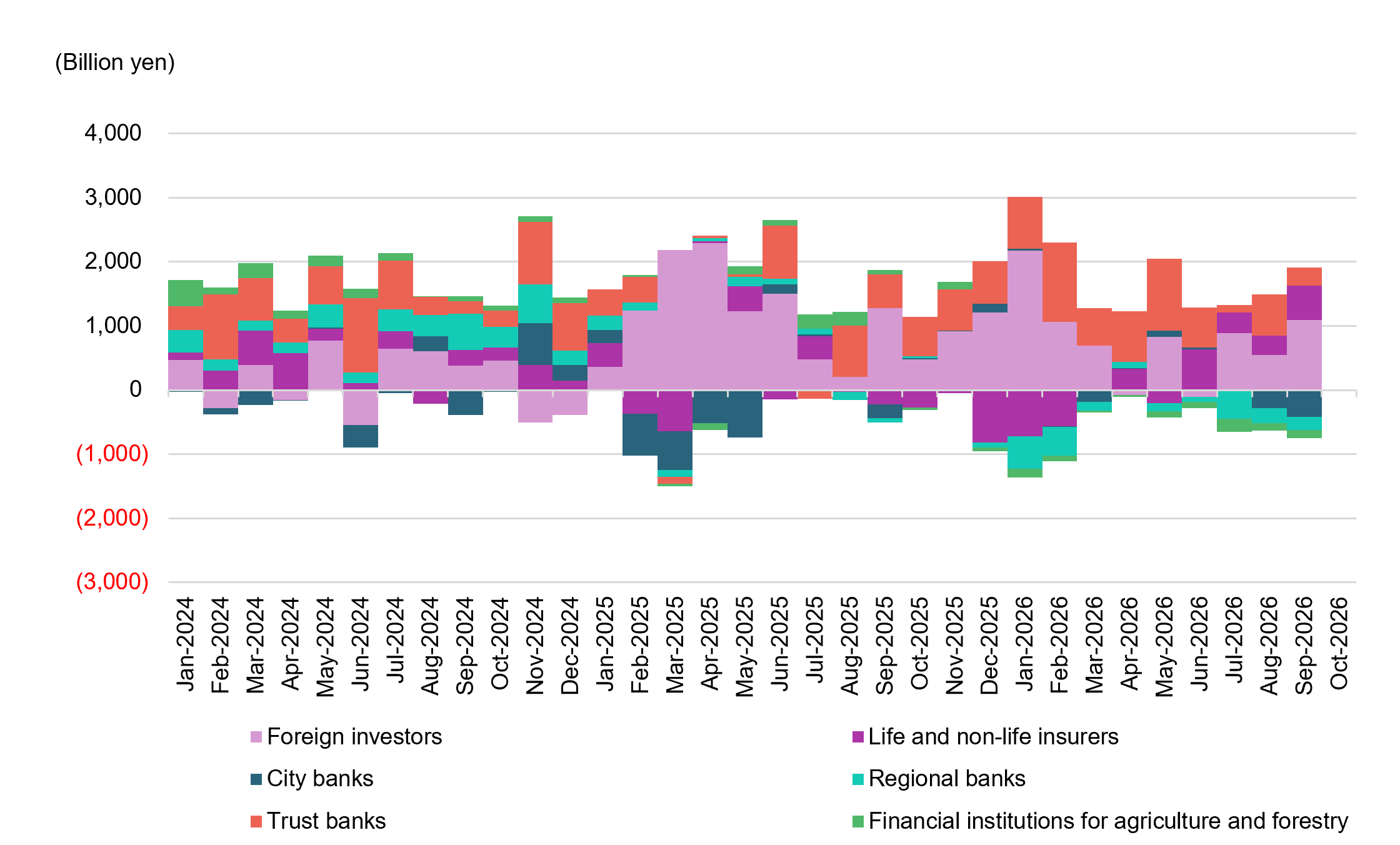
Chart 2 shows that foreign investors account for a large share of transaction value in super-long JGBs. The tenor remains significantly reliant on overseas participation. As such reliance increases, credible fiscal and monetary policies are important to maintaining stability; at the same time, higher yields may present attractive entry points for foreign investors. Foreign demand could therefore supplement recovering domestic institutional demand, potentially helping to stabilise yields.
Chart 2: Trading in super-long JGBs by investor type
Source: JSDA
The currency could add another dimension. A relatively weak yen may make Japanese assets more attractive to an unhedged foreign investor who expects the currency ultimately to appreciate. But the same exposure can amplify losses if yen weakness persists. The case for demand from foreign investors therefore rests not simply on yields, but on a broader assessment of Japanese rates, the yen and confidence in the domestic policy framework.
All in all, foreign investors’ trading participation should not automatically be equated with sustained net investment demand. The nature and durability of these flows warrant further examination.
Conclusion: implications for the JGB market and the broader investment outlook
JGBs have recently made headlines due to their spiking yields, which are often seen to have negative repercussions on global bonds. The return of domestic investor demand for JGBs potentially provides a counterweight to the upward pressure on JGB yields stemming from monetary normalisation, inflation and fiscal concerns. Additional demand from foreign investors could reinforce this effect, particularly if confidence in Japanese monetary and fiscal policy improves.
Nevertheless, strong demand at particular yield levels does not necessarily establish a durable ceiling on yields. Fundamentals, including inflation expectations, fiscal policy and term premia, remain critical factors that influence the direction of JGB yields. As monetary policy normalises, we believe that the dynamic between domestic institutional reallocation and foreign demand will increasingly shape Japanese sovereign yields and cross-border capital flows.