


There is no getting away from the fact that healthcare investors have endured a torrid few years. As global economies recovered from the stresses caused by COVID and Russia’s invasion of Ukraine, cyclical sectors outperformed defensives materially in both 2023 and 2024. Then came the boom in all things AI-related, which intensified the pressure on defensives. Almost every healthcare subsector has had its challenges—stemming from US government policy uncertainty, a post-COVID lull in investment and fears over the impact of AI on the sector. However, as things stand today, we feel increasingly optimistic that policy concerns are easing, investment is returning and it is becoming clear that AI is likely to be a tailwind (rather than a headwind).
All this means that prospects for the sector are brighter than previously anticipated. From a Future Quality perspective, healthcare is worth exploring not just because of its diversification benefits, but also because of its potential to deliver sustainable growth and long-term profitability.
A tale of two healthcare companies: Eli Lilly vs. Novo Nordisk
Of course, finding Future Quality healthcare opportunities is about identifying an individual company’s ability to deliver sustainable high returns on investment, rather than looking at the sector as a whole. Even companies exposed to similar structural growth opportunities can therefore look very different through a Future Quality lens. It is worth exploring the differences between two big pharma companies: Eli Lilly and Novo Nordisk (now rebranded as Novo) to see why we hold one and not the other.
Eli Lilly, a holding for our Global Equity strategy, is a helpful example. Management quality is a key attribute for us and Lilly has excelled under Chair and CEO Dave Ricks. His team has successfully opened new manufacturing capacity needed to meet the unprecedented demand for this generation of GLP-1s whilst continuing to invest in future growth. This has been both organic and inorganic. Clinical trials have continued to underline the potential of Lilly’s pipeline of new drugs, while the company has made upwards of USD 20 billion in acquisitions this year to prepare for growth well into the next decade[1].
By contrast, Novo’s relative operational difficulty in keeping up with demand has contributed to its lost market share. Moreover, pipeline execution has been much more mixed, with some high-profile setbacks prompting investors to question the sustainability of sales growth beyond semaglutide’s patent expiry[2]. At its recent capital markets day, Novo’s senior management acknowledged the need to aggressively step up its business development and M&A plans but failed to convince investors of a credible long-term path[3].
After both companies enjoyed the early stages of the GLP-1 boom, the chart below shows the extent to which Lilly’s management team has outperformed its Danish peers. It will not be easy (or cheap) for Novo to catch up, leading us to question the direction of future returns on investment.
Chart 1: Stock returns of Eli Lilly and Novo vs. the MSCI ACWI Healthcare Index
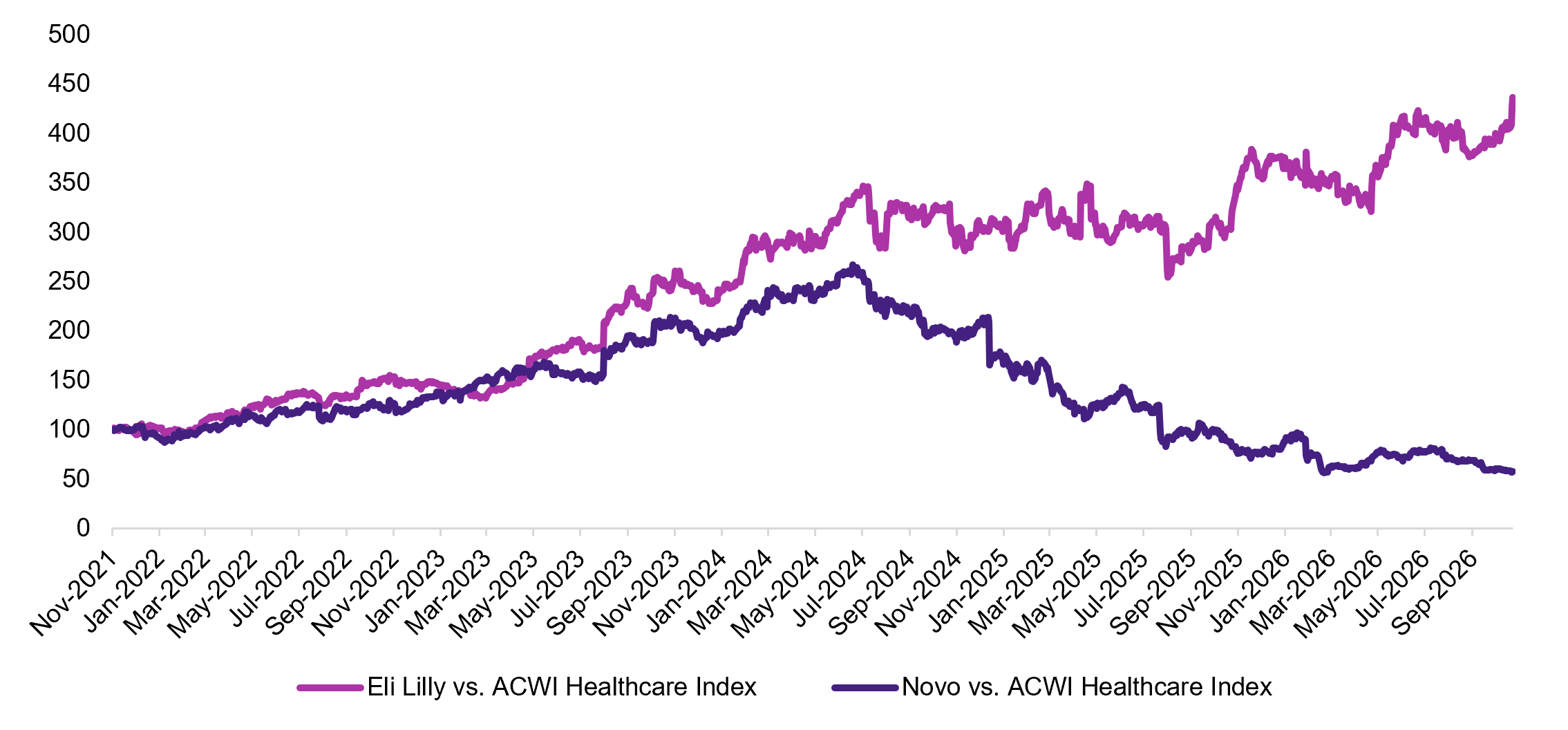
Rebased to 100 on 8 November 2022.
Source: Bloomberg, 26 October 2026. Past data or any forecast is not necessarily indicative of future outcome.
The life sciences and biotech recovery is continuing unimpeded
One of the areas where valuations have fallen significantly over the last three years has been life sciences tools & services, for three reasons. First, many of these companies were a victim of their own success during the COVID years. Clinical research and manufacturing capacity was rapidly added to quickly deliver COVID vaccines, but this created a big air pocket in demand once COVID disappeared into the rearview mirror. Second, the Trump administration’s approach to the sector and attempts to cut life science research spending in the US brought about a loss of confidence in the sector. And third, there was a fear that large language models (LLMs) would significantly disrupt the life sciences sector, which resulted in companies being derated further.
There are good reasons to suggest those second and third concerns may be less significant than initially feared. For example, despite the noises coming from the Trump administration about cutting life science research funding, it has made little headway. In 2025, the Trump administration’s draft budget proposed cutting funding for the National Institutes of Health (NIH) by 40%[4]. In the end, however, Congress maintained funding at the same level as the previous year[5]. In fact, research funding is one issue where Congress has demonstrated broader bipartisan support for increased, rather than reduced, spending.
Chart 2: National Institutes of Health (NIH) annual funding
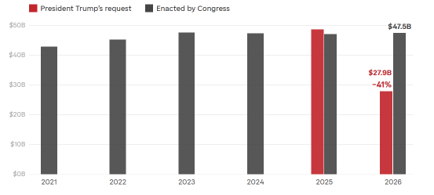
Source: Congressional Research Service, Report R43341: National Institutes of Health (NIH) Funding: FY1996-FY2026. Chart adapted from NPR.
While the market was quick to react to negative headlines around US government support for life science research, the reality is that the funding is still there. Confidence in the sector is slowly starting to return and the uptick in biotech funding ultimately benefits contract research organisations (CROs) and tools companies. Previous cycles suggest that this funding cycle will unfold over several years; right now, the recovery is only a few months old. Therefore, while we are always looking at how other economic variables, including interest rates, affect credit availability, there are reasonable grounds for genuine optimism about this part of the market.
Talk of AI eating into life sciences may be overblown
In many respects, investors have been assuming AI would transfer power from the life science tools companies straight to the pharmaceutical companies. So, it seemed logical when life science tools companies took another leg down in February of 2026, after one of the first LLMs started talking about its application in life sciences.
Chart 3: MSCI ACWI Life Science Tools & Services Index vs MSCI ACWI Healthcare Index
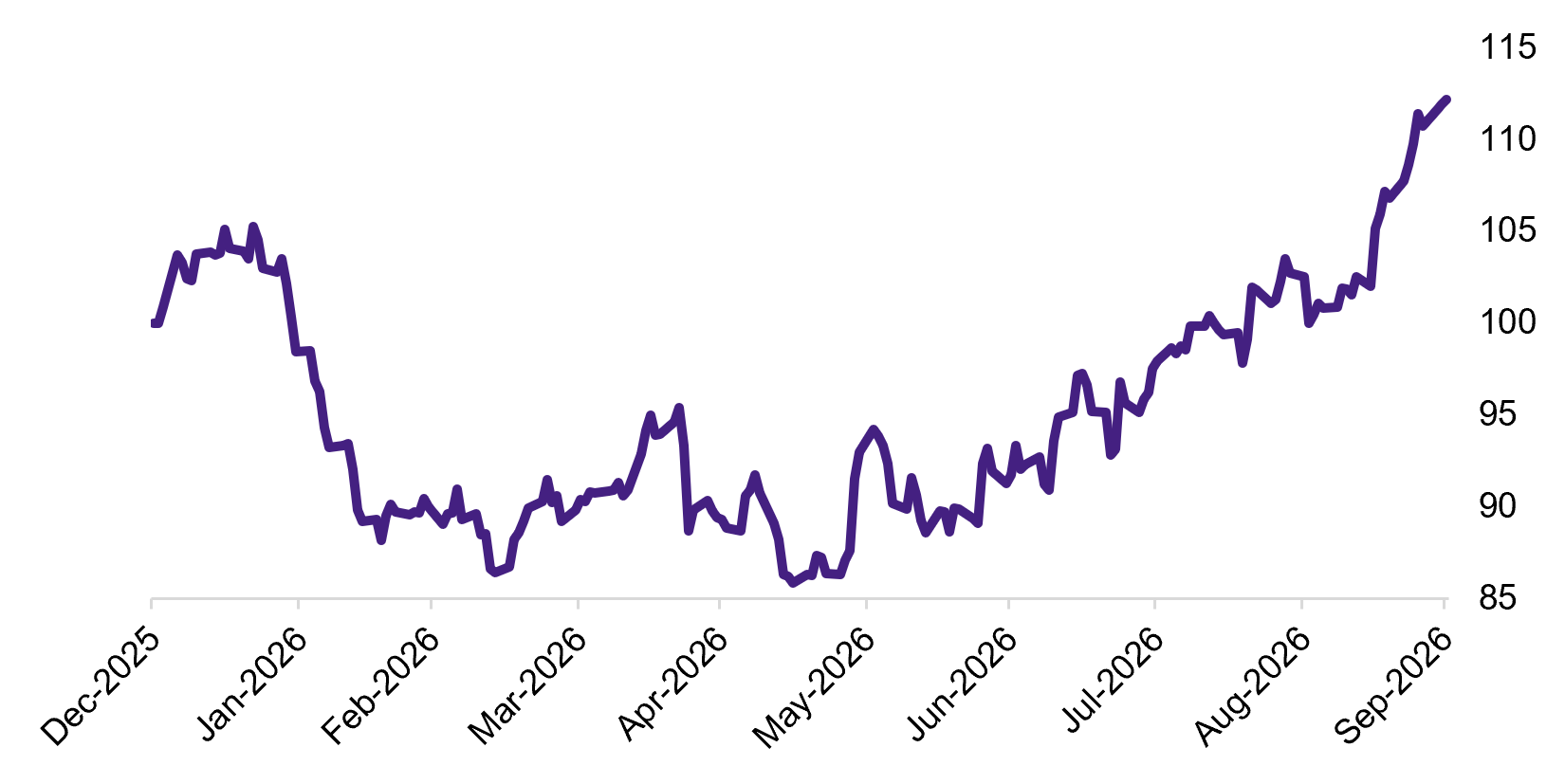
Rebased to 100 on 31 December 2025.
Source: Bloomberg, 26 October 2026. Past data or any forecast is not necessarily indicative of future outcome.
However, evidence suggests AI is allowing pharma companies to explore more targets, which is boosting demand for the life science tools and services infrastructure. We have heard anecdotally of companies talking about a potential tenfold increase in the number of new molecules they can test. All these new molecules ultimately need proof of concept that can only be delivered in the wet lab. Life science tools and services companies therefore still hold the key to testing whether AI can deliver real-world results, which puts them in a strong position.
So, we believe that the recovery of shares in this area is in recognition that this initial response was an overreaction. Our view is that there is still a long way to go before the real commercial applications of this technology start to filter through, and that, far from this being a negative for life science tools and services, this technology is going to be a meaningful positive.
Impressive clinical trials this year augur well
News of clinical trial progress is usually well received by investors, and the market’s response to Moderna and Merck’s joint announcement of a personalised mRNA cancer vaccine that cut the recurrence and spread of melanoma[6] was overwhelmingly positive, adding billions to the market capitalisation of each company. Such figures show the elevated interest in this field. However, for mRNA excitement to be justified, the technology will have to prove its efficacy in other types of tumours where it hasn't worked particularly well in the past. We therefore are cautiously optimistic on the direction of travel.
Is the pendulum swinging back in healthcare’s favour?
Within the Future Quality philosophy, healthcare has always been a natural fit. We look for companies with sustainably high or improving returns on investment over the long term, capable of showing sustainable sources of growth and high profitability. The portfolio companies we have held for the longest have tended to be those that tap into healthcare demand in a way that saves money for healthcare systems and delivers good outcomes for patients. Where that Venn diagram of cost cutting and steady long-term demand growth intersects is where we have tended to find our highest conviction ideas.
The market has been obsessed with one central theme over the course of the last three years, but we see the pendulum swinging slowly back in favour of healthcare, not only for its diversification benefits but because of selective areas of long-term growth and profitability. From here, provided companies can demonstrate how less regulatory pressure, successful AI deployment and more drug discoveries translate into earnings growth, the opportunity currently “hiding in plain sight” may be well and truly out in the open.
References
[3] https://www.ft.com/content/c586a8c2-4772-4a90-85a5-5ca879a32442?syn-25a6b1a6=1
[5] https://www.npr.org/2026/09/24/nx-s1-5931971/trump-nih-science-funding-disruptions-charts
Reference to any particular security or sector is purely for illustrative purposes only and does not constitute a recommendation, nor to be relied upon as financial advice in any way. There can be no assurance that any performance will be achieved in any given market condition or cycle. Past performance or any prediction, projection or forecast is not indicative of future performance.