


This article is based entirely on insights presented by Louis-Vincent Gave, CEO of Gavekal Research, at Amova Asset Management’s Foreword event in Singapore on 1 September 2026. It has been edited and organised by Amova AM’s Asian Editorial Team for clarity and does not represent independent analysis by Amova AM.
A turning point for the investment regime
Investment regimes rarely change overnight. More often, a succession of shocks exposes assumptions that had become embedded in asset prices. At our recent Foreword event in Singapore, we focused on themes presented by Louis-Vincent Gave, CEO of Gavekal Research, in which he suggests that several such assumptions are now being tested at the same time. In his view, energy and commodity flows can no longer be regarded as frictionless, developed-market government bonds may not always offset equity risk, artificial intelligence (AI) requires an extraordinary mobilisation of capital and Asia’s largest economies are moving through very different policy cycles.
For much of the post-World War II period, many investors operated on the assumption that financial claims such as US Treasuries could readily be exchanged for essential commodities, that sea lanes would remain secure and that the US would continue to support the global trading system. In Gavekal Research’s analysis, disruption around the Strait of Hormuz challenges that framework by linking financial confidence more directly to the physical availability of energy, food and industrial inputs.
The first phase of a supply shock often involves dislocation. Companies may reroute cargoes, draw on inventories and accept higher freight and insurance costs, allowing economic activity to continue, although less efficiently. If the shock persists, inventories may be depleted and alternative routes may reach capacity, shifting the system from dislocation towards constraint. Physical availability, rather than price alone, can then become the binding factor. This framework helps explain why markets may initially appear resilient even as operational stress rises: earnings data can lag changes in logistics, while companies may temporarily protect production through stockpiles and additional working capital.
When energy becomes the macro variable
Energy is a fundamental input into transport, industrial production and services, so disruption to a concentrated supply corridor can spread well beyond the quoted oil price. Louis-Vincent Gave highlights the Middle East’s role in supplying oil, natural gas, fertiliser and other industrial-processing inputs. Constraints in any of these markets can raise production, transport and food costs through different channels.
Gavekal Research notes that China’s response helps explain why the impact was more visible in refined products than in crude oil. Its analysis indicates that China entered the disruption with substantial oil inventories, enabling it to reduce purchases as prices rose, while restrictions on diesel and gasoline exports protected domestic supply. Combined with reported refinery outages across the Middle East, Russia and Ukraine, this may have tightened refined-product markets even as crude benchmarks remained relatively contained. In this interpretation, rising diesel and transport costs provided a clearer signal of strain across shipping, trucking and industrial supply chains.
These pressures are transmitted unevenly across Asia. Net energy importers may experience weaker trade balances, higher inflation and pressure on corporate margins, while commodity producers may benefit from stronger realised prices but remain exposed to freight disruption, weaker downstream demand and policy intervention. Food security creates an additional link to households because diesel, natural gas and fertiliser costs affect both agricultural production and distribution.
The same shock can therefore produce very different outcomes across sectors. Airlines and consumer companies may face higher transport and input costs, refiners may benefit from tighter product markets, and chemicals, utilities and banks may respond according to their energy exposure and financing position. Balance-sheet strength, inventory access and pricing power may consequently become more important differentiators than broad sector labels.
When bonds stop diversifying portfolios
One of the most significant consequences of a changing inflation regime may be the erosion of traditional portfolio diversification. For decades, developed-market government bonds were expected to offset equity weakness. That relationship becomes less reliable when inflation and fiscal uncertainty make the discount rate itself a source of risk.
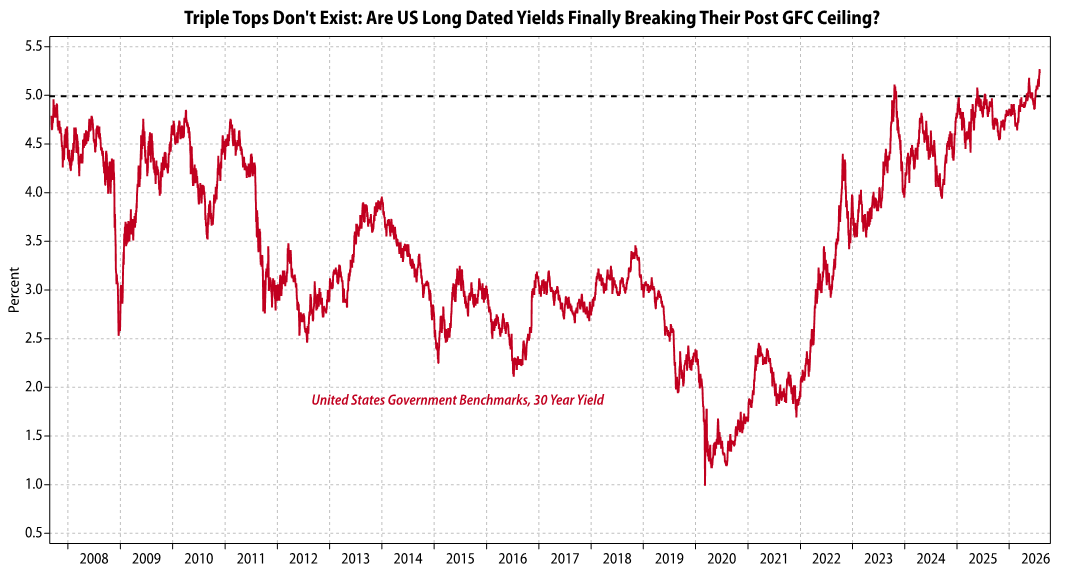
Gavekal Research notes that long-dated US Treasury yields have moved beyond their post-Global Financial Crisis (GFC) range, potentially reflecting a structural, rather than a cyclical, shift. Greater investment in strategic reserves, electricity grids, defence and digital infrastructure reinforced by governments’ focus on self-sufficiency could sustain demand for capital and reduce the relative appeal of sovereign bonds as a store of precautionary savings.
A higher risk-free rate affects every asset class. It reduces the present value of distant cash flows, raises refinancing costs and increases the return required from private-market projects. It can also redistribute profitability towards financial institutions that benefit from positive nominal rates.
Chart 1: US 30-year Treasury yield moving out of its post-GFC range
Source: Gavekal Research, Macrobond
AI’s trillion-dollar funding challenge
The enthusiasm surrounding AI has largely focused on productivity. However, the investment implications extend beyond technological adoption. Building data centres, semiconductors, power systems and network infrastructure may become one of the decade’s largest capital-allocation exercises. Gavekal Research cites an external estimate that global data-centre investment could reach US dollar 6.7 trillion through 2030.
This creates a central investment dilemma: AI can generate substantial productivity gains while still producing uneven returns for investors. The key questions are who funds the infrastructure, who captures the economics and how competition affects returns on incremental capital. Initial expectations centred on the hyperscale platforms able to finance the required expenditure before market leadership broadened towards semiconductor suppliers as spending flowed through the supply chain. The emergence of Chinese large-language models and semiconductor capability could further increase competition, lower adoption costs and transfer more value to users while compressing margins for incumbent suppliers.
Uncertainty over which companies will ultimately capture the returns from AI infrastructure creates a funding risk: businesses may need to commit substantial capital well before revenues become dependable, while competition could weaken the margins available to repay that investment. This risk becomes more consequential when the cost of capital is high. Companies with durable demand, strong balance sheets and the capacity to fund investment internally may be better placed than projects reliant on repeated external financing or aggressive terminal-value assumptions.
On earnings quality, Louis-Vincent Gave contrasts aggregate US corporate profits with reported S&P 500 earnings and identifies periods of divergence. In his analysis, part of the recent growth in reported S&P 500 earnings reflects “other income”, including revaluations and capital gains on earlier investments. These gains can support headline results but may be less repeatable than earnings generated through core operations, making the composition of profits relevant when assessing the durability of market leadership.
China’s industrial transformation
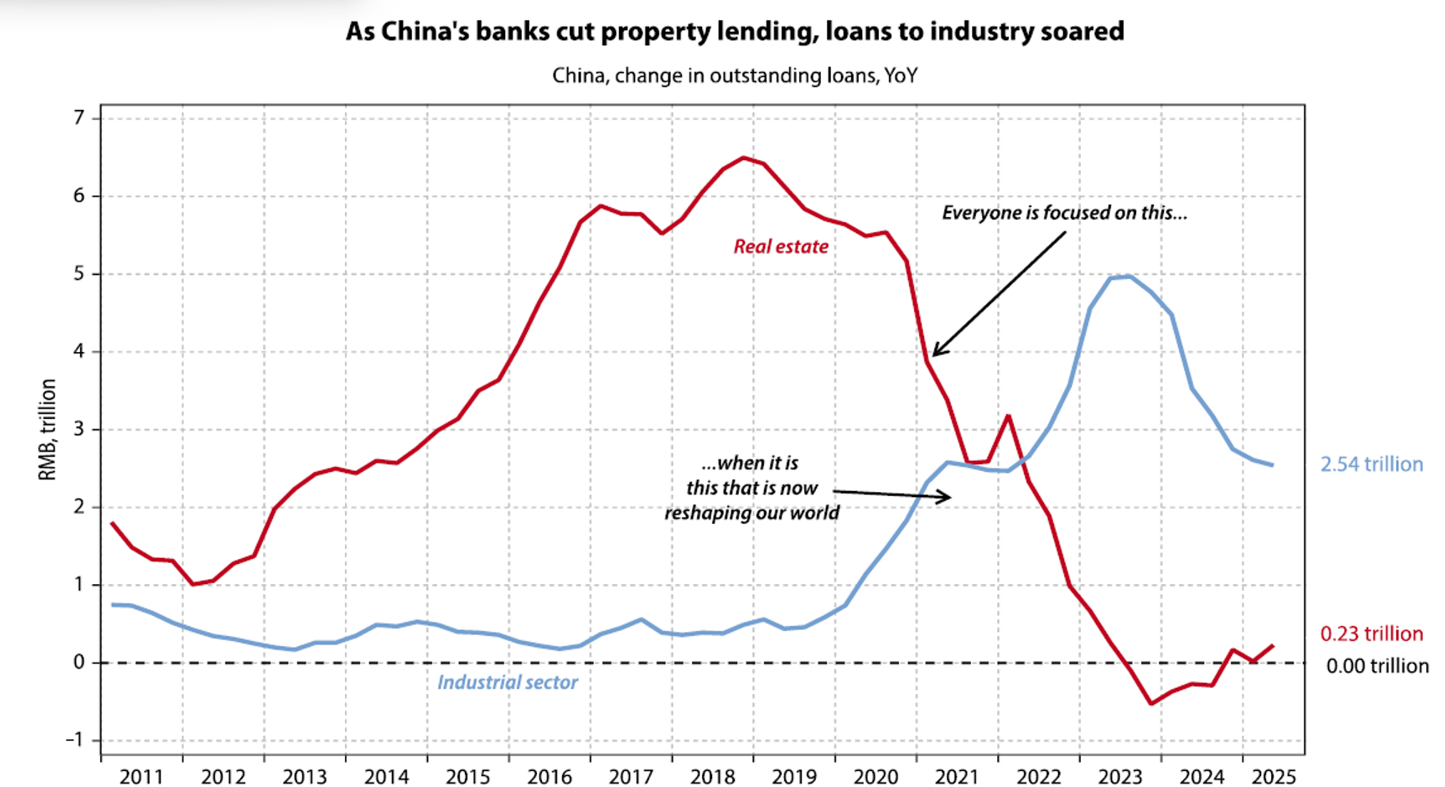
China’s property slowdown has dominated macroeconomic discussion, but Gavekal Research identifies a different structural development: the redirection of credit towards manufacturing and strategic industries. Real-estate lending has weakened while industrial financing has increased, supporting a transition from a property-led growth model towards a more state-directed industrial model.
Louis-Vincent Gave places the policy pivot in 2018, when US restrictions on semiconductor access highlighted China’s dependence on imported technology. Policymakers subsequently directed commercial-bank lending away from real estate and towards industrial self-sufficiency. Over the following years, this supported rapid gains in automobiles, factory automation, robotics, electricity generation, transmission and storage, with progress also extending into biotechnology and pharmaceuticals.
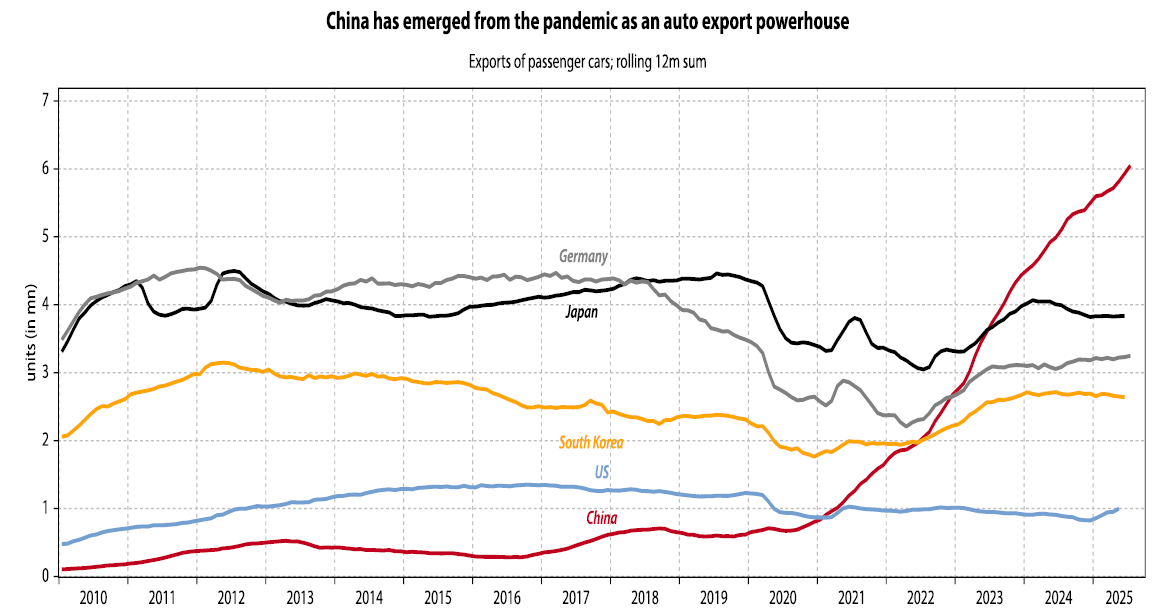
Gavekal Research presents the expansion of China’s automobile exports as evidence that industrial capability continued to advance even as household confidence weakened. In this interpretation, scale, infrastructure and policy support have contributed to competitiveness in automobiles, energy equipment and other strategic sectors. This supply-side strength could alter global trade and competitive dynamics regardless of the near-term path of domestic property activity.
China nevertheless faces material domestic demand-side pressures. Gavekal Research highlights a sharp decline in births and uneven consumer confidence across demographic groups. The resulting economy can be strong in production capacity but cautious in consumption and private investment. Louis-Vincent Gave describes annual births as having fallen from about 18 million in parts of the 2010s to fewer than eight million in 2025, alongside weak wage progression, limited career advancement and household balance-sheet damage associated with property. In his analysis, restoring confidence among younger households is therefore increasingly central to the policy outlook, and a stronger renminbi could contribute to rebalancing by transferring purchasing power from producers towards consumers.
For investors, this distinction argues against treating China solely as a cyclical recovery trade. The more durable opportunity set may lie in companies and supply chains aligned with industrial upgrading, while the principal macro risk is whether household confidence can recover sufficiently to support a broader expansion. Currency behaviour is another important signal. A stable or appreciating renminbi could improve the total-return calculus for foreign investors, but must be assessed alongside growth, policy and geopolitical risks.
Chart 2: China’s credit reallocation and automobile export rise
Source: Gavekal Research, Macrobond
Japan’s monetary regime shift
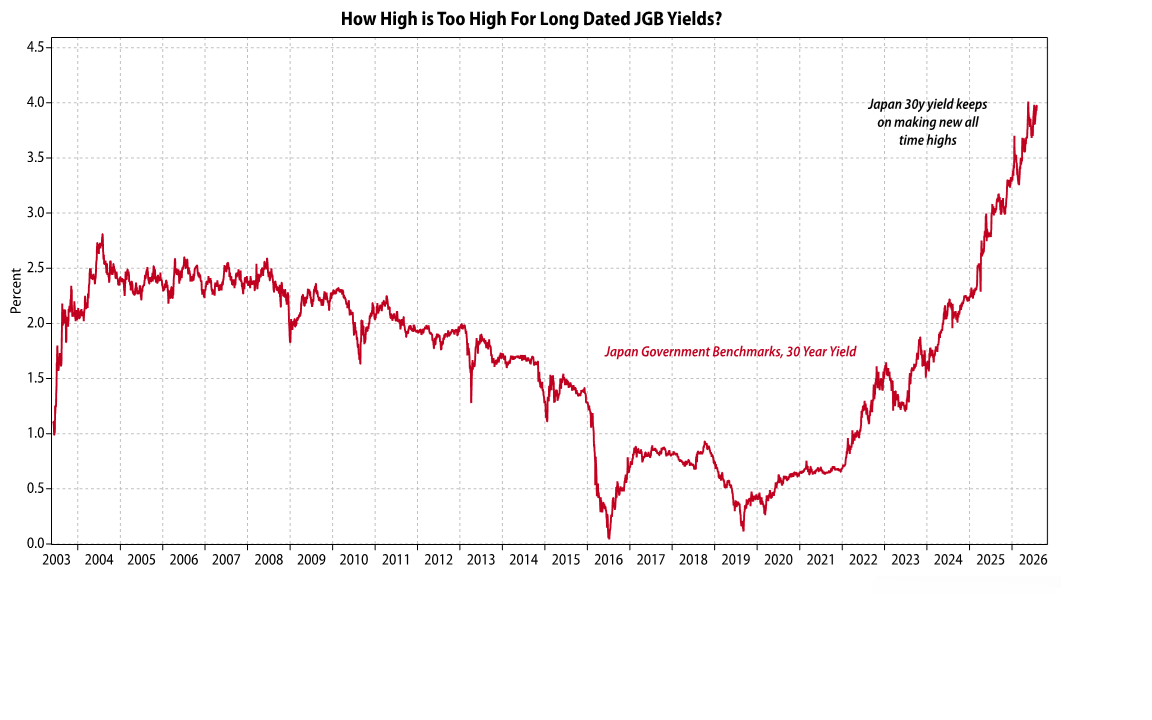
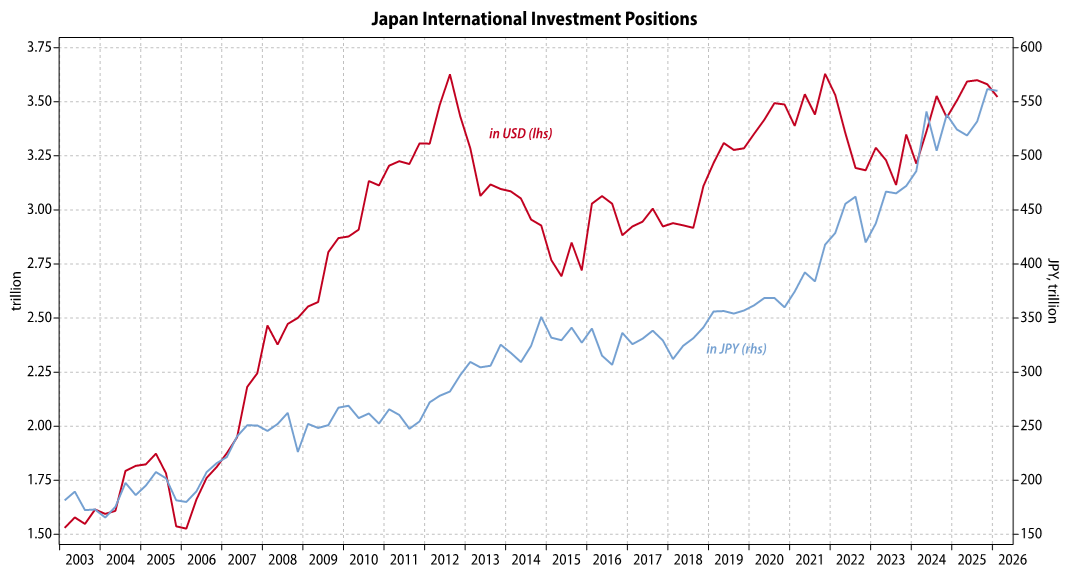
If China represents industrial transformation, Japan may represent monetary transformation. For decades, low domestic yields encouraged Japanese institutions to allocate savings overseas, reinforcing capital outflows and transmitting low rates to global markets. Rising long-dated Japanese government bond (JGB) yields raise the question of when domestic assets become sufficiently attractive to bring part of that capital home.
Louis-Vincent Gave adds a near-term policy dimension, presenting Japan as a rare major economy where the central bank might still raise interest rates. Together with an undervalued yen, this reinforces the possibility that Japan’s rate and currency settings are moving away from the ultra-accommodative framework that shaped global capital flows for much of the post-GFC period.
Gavekal Research estimates that Japanese investors hold overseas assets equivalent to more than 80% of gross domestic product. Rising domestic yields could make Japanese assets more attractive to local investors and encourage some repatriation of overseas capital. Even gradual repatriation could reduce demand for foreign bonds, affect currency-hedging costs and influence the valuation of Japanese financial companies, although the effects would not be uniform. Banks and insurers may benefit from a more positive yield environment, while leveraged borrowers and long-duration assets may face higher discount rates.
Japan’s transition also has a wider signalling function. If the economy most closely associated with deflation is moving towards a more normal inflation and rate environment, investors should be cautious about treating the ultra-low-rate period after the GFC as the default state of the world. Cyclical bond rallies remain possible, but the structural starting point may be changing.
Chart 3: Japan’s rising domestic yields, overseas assets
Source: Gavekal Research, Macrobond
Inflation outlook and conclusion
Louis-Vincent Gave believes that inflationary pressures are likely to persist, supported by elevated energy prices, loose fiscal policy in Western economies and broadly accommodative monetary conditions. At the same time, firmer Asian currencies could reshape regional purchasing power and capital flows. A banking-led return to deflation appears less likely while lending is expanding and bank balance sheets remain comparatively healthy; similarly, there is limited evidence that monetary policy is sufficiently restrictive. While higher bond yields could constrain activity and inflation, policy efforts to limit yields could weaken that transmission channel.
The coming years are likely to remain capital-intensive. Investment in electricity-grid resilience, together with the rebuilding of depleted commodity inventories, may strengthen economic resilience while also sustaining inflationary pressures, absorbing liquidity and raising the cost of capital.
Asia sits at the centre of this adjustment. China is comparatively less constrained by domestic inflation and may have greater scope for stimulus if external trade and energy uncertainties ease. Meanwhile, Japan’s shift towards higher interest rates, a firmer renminbi and broader changes in Asian currencies could influence capital flows and asset valuations across the region. The resulting environment is unlikely to produce uniform outcomes: balance-sheet strength, pricing power, access to energy and the capacity to fund investment internally may become increasingly important differentiators.
The broader implication is not that a single crisis will define the outlook, but that several long-standing assumptions may be changing together. Energy security, industrial policy, AI infrastructure and cross-border capital flows point towards a more physically constrained and funding-intensive global regime. Inflation outcomes may therefore depend increasingly on whether higher yields restrain demand or whether fiscal and monetary policy continue to accommodate investment in resilience.