


The biggest bottleneck is not processing power or data storage, but electricity
Artificial intelligence (AI) is restructuring the global economy at a speed that few anticipated. AI is not purely a technology story, but also an energy story. The infrastructure required to support it, from data centres and power grids to storage and transmission networks, is driving a structural increase in electricity demand that will define energy investment for the next decade and beyond.
After two decades of essentially flat demand, global electricity consumption is projected to rise by more than 40% over the next decade, driven by AI, digitalisation and new forms of industrial production. Supporting global AI workloads alone may require approximately US dollar (USD) 5.2 trillion in capital expenditure by 2030, much of it from the large technology companies, known as hyperscalers, that are already expanding their data centre networks rapidly.
Chart 1: Hyperscalers’ cumulative capital expenditures 2020-2030 (USD)
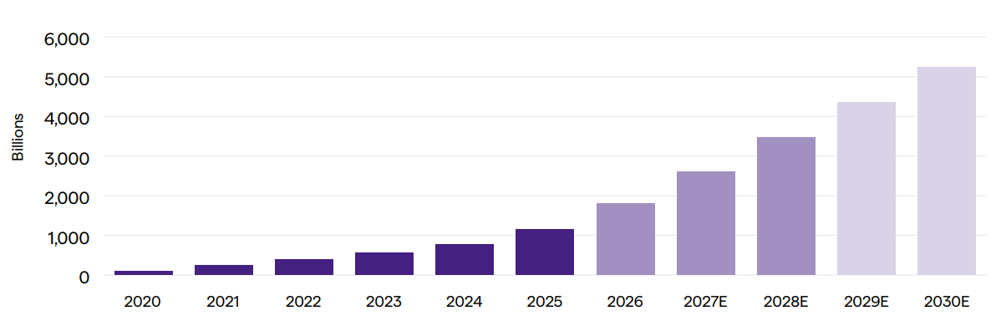
Source: Bloomberg BEST estimates, 2026.
Meeting this surge in demand will require a sixfold increase in the rate at which new power generation and transmission capacity is built. The capital required to build the renewable generation capacity, grid upgrades and storage infrastructure that digital economies depend on is large, long-dated and suited to debt financing. Green bonds, with their use-of-proceeds discipline and direct link to underlying infrastructure assets, are one of the most practical tools for directing that capital at the scale and speed the transition now requires.
This has a direct implication for how to think about some of the largest capital expenditure programmes currently under way. The build-out of AI infrastructure is a case in point. A meaningful portion of it will be debt-financed. AI-related debt already accounts for around 13% of the investment grade index, up from approximately 6% in 2020, and that proportion is likely to continue rising.
For investors seeking exposure to the AI theme, the question is where in the capital structure does that exposure make the most sense. The upside of AI, if the technology delivers on its promise, accrues primarily to equity holders. The debt issued to fund the infrastructure carries the downside risk without the corresponding upside participation.
The case for diversifying AI exposure
It is worth noting that the debt being issued by the major technology companies to help fund AI infrastructure is, almost without exception, conventional unlabelled corporate debt. Investors who hold this debt through passive index exposure receive no use-of-proceeds transparency, no direct link to the underlying assets being financed, and no sustainability benefit. They are simply lending money to large technology companies at a fixed rate, with all the downside risk that entails if the AI growth story disappoints.
Green bonds, by contrast, finance the energy infrastructure that the hyperscalers depend on but do not control. The utilities, grid operators and renewable energy providers that supply power to data centres provide services that are likely to remain in demand irrespective of what happens to the technology companies consuming that power. Energy demand is unlikely to disappear if an AI company misses its revenue targets, faces regulatory intervention or struggles under the weight of its own debt. In that sense, sustainable fixed income offers investors exposure to the infrastructure layer that underpins AI, without the concentration risk that comes with owning hyperscaler debt directly.
The energy transition, the demand for digital infrastructure and the shift toward more resilient economic systems are usually framed as equity stories. The companies developing renewable energy, constructing data centres and upgrading power grids are growth businesses, and growth businesses attract equity capital. But equity is the wrong lens for understanding where most of the capital actually needs to go. The physical systems that modern economies depend on are not built on the logic of venture returns. They are long-dated, capital-intensive and generate stable, predictable cash flows over extended time horizons. These are the characteristics that more adequately define debt financing, rather than equity.