


One of the most common objections to investing in green bonds has always been the “greenium” – the belief that investors must accept a lower yield for choosing a green bond over a conventional equivalent. For years, this was treated as an established fact of the market, the cost associated with the sustainability label. However, our latest research suggests the picture looks more nuanced. In the early years of the green bond market, a greenium did exist. Supply of green bonds was limited, demand from ESG‑focused investors was concentrated, and prices reflected that imbalance. But as the market has grown and diversified, the assumption that investors must sacrifice yield has become increasingly difficult to support. The question is not whether the greenium once existed, but whether it still does, and if so, where.
A broader examination of the bond market
Most research into the greenium has been methodologically narrow. A notable recent study examined around 3,500 bonds, focused exclusively on euro‑denominated investment grade debt, and covered only the last three years of market data. Conclusions drawn from a sample that is constrained in scope risk reflecting the parameters of the study as much as the market itself.
Our research team took a different approach. Using ICE index data covering the entire USD 70 trillion global bond market, our team built a dataset of approximately 2.1 million observations collected on a monthly basis from 2017 onwards. The dataset spans multiple currencies, with EUR‑denominated bonds accounting for around 60% and USD bonds around 20%, with GBP, AUD and CAD making up most of the remainder.Rather than looking at the market as a single aggregate, our research examined the cross‑section of data across currencies, sectors, ratings and time periods.
What the research shows
Our findings challenge the conventional view of the greenium in several important ways:
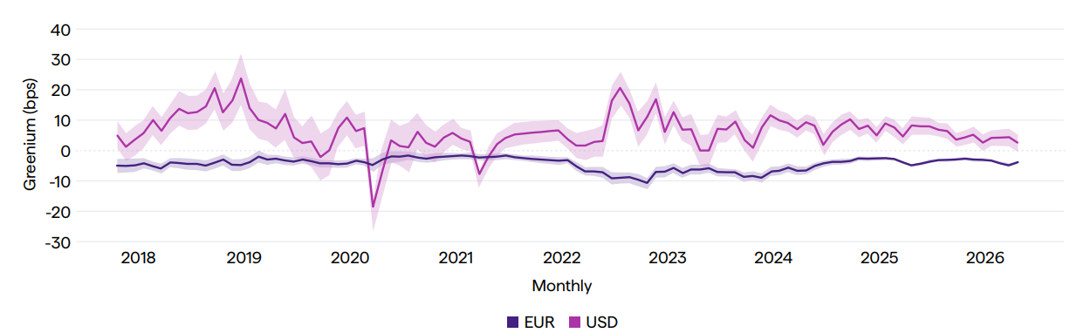
- Within EUR‑denominated markets, green bonds often offer yields comparable to or higher than conventional equivalents
- Where a modest premium has emerged in Europe, it appears concentrated in the period from 2023 onwards and is likely linked to broader market conditions
- In the USD market, green bonds have consistently offered investors higher yields than traditional equivalents
For the USD market, the picture is clearer. Our research finds green bonds in the US have consistently offered investors higher yields than traditional equivalents across the study period. Investors have not been paying more for the sustainability label, and in many cases, they have been paid more for holding it.
Chart 1: Greenium by month and currency (negative values indicate higher prices or lower yields for green bonds)
Source: Amova Asset Management, ICE Data 2026
What earlier studies may have missed
Many of the pricing differences associated with green bonds may actually reflect broader bond characteristics rather than the green label itself. Green bonds are often issued by higher‑quality borrowers and therefore tend to carry lower coupons, while lower‑quality issuers generally need to offer higher coupons and wider spreads to attract investors.
Green bonds also tend to have longer durations, which naturally leads to wider spreads because investors are exposed to interest rate and inflation risks for longer. Other factors, such as convexity, liquidity and volatility, also play an important role in pricing. Once these structural factors are taken into account, evidence for a consistent green premium becomes much weaker.
What this means for investors
The research suggests that fears about giving up returns by investing in green bonds are largely overstated. In the US, green bonds have consistently offered higher yields or traded at lower prices than comparable conventional bonds. In Europe, green bond yields have generally been similar to conventional bonds, with any recent differences driven more by specific sectors and market conditions than by the green label itself.
More importantly, any remaining yield differences can be managed relatively easily through sector and currency positioning. In some parts of the market, particularly in the US where negative sentiment towards ESG has pushed green bond yields higher, investors are actually being rewarded rather than penalised for choosing the sustainable option.
*While diversification can help reduce risk in a portfolio, it does not guarantee profits or protect against losses in a declining market.
If you have any questions on this report, please contact:
Amova Asset Management team in Europe
Email: EMEAenquiries@amova-am.com
Sustainable Fixed Income in a Disrupted, Energy-Hungry World
Download your Sustainable Fixed Income Investment Guide
Download (UK) Download (Europe ex UK)