

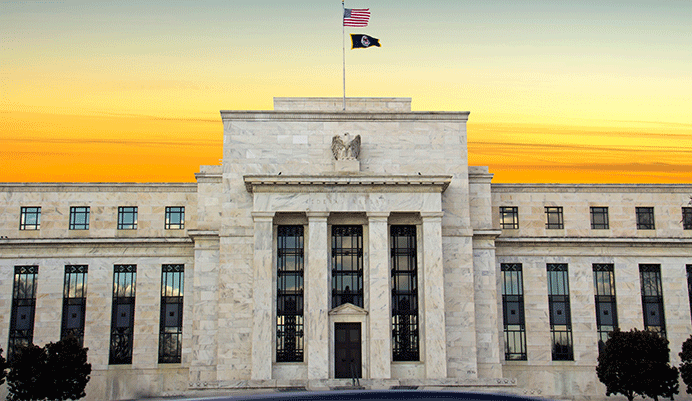
At its April meeting, the Federal Reserve voted 8-4 to hold the benchmark federal funds rate at 3.5–3.75%, marking its third consecutive pause. The Fed’s statement cited elevated inflation, partly reflecting the impact of the Middle East conflict on energy prices, as well as heightened uncertainty surrounding the US economic outlook as factors behind the decision.
Policy dissents were the highest in 34 years, with four members dissenting. Notably, three of the four dissenters focused on the Fed’s easing bias—an element not officially mentioned elsewhere in the statement itself. The lack of a formal easing bias renders the statement neutral; any residual easing bias is inferred from dissenters explicitly rejecting an easing tilt. As expected, one dissenter continued to favour a 25 basis point rate cut.
On balance, the dissents shift the Fed’s stance modestly away from an easing bias. Instead, the Fed appears to have moved to a two-sided, higher-for-longer regime, where easing is no longer the baseline. Markets have repriced accordingly to reflect this shift.
Market response: relative credibility
Following the decision, Fed Funds futures reduced their implied probability of rate cuts over the remainder of 2026, while beginning to price in an increasing probability of rate hikes going into 2027. US Treasuries (USTs) slumped across the curve, led by short-tenor yields. In contrast to the rise in UST yields, the Bloomberg dollar spot index declined modestly.
In spite of this, dollar/yen remained on an upward trajectory, reflecting the dominance of yen weakness in the background. In this context, against a backdrop of significant uncertainty for both US and Japanese economies, the market reaction may be read as a relative, rather than absolute, endorsement of Fed credibility. This interpretation is seen to be reinforced by widening US-Japan interest rate differentials and perceived Bank of Japan (BOJ) dovishness.
It is also possible that these moves indicate that markets have more confidence in the Fed’s inflation-fighting resolve than that of the BOJ. In the longer term, credibility is expected to have more than marginal implications for both economies.
Powell’s outgoing message put credibility front and centre
During his post-meeting press conference, Fed Chair Jerome Powell noted that, despite visible divisions in the Federal Open Market Committee (FOMC) board over policy guidance, markets continue to expect inflation to eventually settle around the Fed’s 2% target—an outcome he interpreted as a strong endorsement of the Fed’s inflation-fighting credentials. In other words, although there may be uncertainty over the path of inflation, markets still have conviction in its destination, thanks to these credentials.
Credibility will pay longer-term dividends
As Powell prepares to pass the baton to the next Fed Chair, his focus on credibility throws the spotlight on the Fed’s implicit long-term rate target. The underlying logic is that long-term yields stay anchored, in large part, by the markets’ anticipation that the Fed will ultimately succeed in bringing inflation under control—an outcome that Powell suggests should not be taken for granted.
Powell also indicated that considerations of central bank credibility influenced his decision to remain on the FOMC after stepping down as Chair, unlike many of his predecessors who resigned from the board following the end of their tenure.
Additionally, Powell noted that developed economies specifically guard the independence of their central banks from short-term political pressures; this reflects the inherent tension between the near-term incentives of elected officials and the long-term goal of protecting real household incomes, which has ramifications for all developed economies.