


As expected, the Bank of Japan (BOJ) Monetary Policy Committee (MPC) kept the overnight call rate unchanged at 75 basis points today, following a 6-3 vote. Ahead of the BOJ’s decision, markets had been gearing up to challenge the central bank’s inflation-fighting credibility, with dollar/yen hovering at around 160 and Japanese government bond (JGB) yields edging higher.
In spite of a substantial upgrade to the central bank’s inflation forecasts (from a median of 1.9% in January to 2.8% in April), as well as the coherence of the arguments expressed by the three dissenters, the release, combined with Governor Kazuhiko Ueda’s subsequent press conference, fell short of a strong commitment by the BOJ to act on Japan’s increasing upside inflation risks. There were some signals that the initial statement and Outlook report began to mitigate concerns that we had flagged in our pre-meeting analysis (Japan amplification risk: yen weakness and terms-of-trade shock). However, in their totality, the policy communications fail to rule out the risk of a mutually reinforcing yen depreciation and rising JGB yield loop. The downgrades to the BOJ’s growth forecast present, on the surface, a conflicting risk skew which is a shift from its January narrative of an economy gradually recovering from its lost decades of deflation. But the relative hawkishness of the BOJ’s Outlook report contrasted with the message of ongoing data-dependence conveyed by Ueda.
Dissenters: higher in number, unified in stance
Adding a definitively hawkish bias to the BOJ’s characteristically restrained policy communication, the dissents by policy board members Hajime Takata, Naoki Tamura and Junko Nakagawa were remarkable in their unified logic and direction, with each arguing for a rise in the overnight rate to 1%. Moreover, Takata, who has typically presented relatively hawkish views within the MPC, made an unusually direct assessment that the BOJ’s price stability target was “more or less achieved”. Had the dissenting votes been fewer or lacked a coherent argument, the statement may have sent a weaker signal regarding the BOJ’s inflation-fighting resolve.
Outlook: aware of the risk of falling “behind the curve”
The BOJ’s April Outlook represents a potential regime shift from its January Economic Outlook. The rise in crude oil prices as a result of the Iran conflict and the associated growth headwinds were cited as the primary catalysts to downgraded growth forecasts. Even so, the BOJ foresees growth at a “moderate” rate, “underpinned by factors such as the government’s various measures and accommodative financial conditions”, alongside “high levels of profits in the corporate sector”.
At the same time, the core CPI outlook, upgraded from a median rate of below 2% in 2026 to “in the range of 2.5% to 3%” —clearly above target—is still seen to be motivated meaningfully by temporary/cost-push factors. Importantly, however, the balance of risks did not owe entirely to externally led, cost-push factors. The underlying growth picture, wage-price dynamics and the BOJ’s longer-term risk analysis were also supporting factors.
In the context of the full report, the Outlook report on its own may be interpreted as an acknowledgement of heightened inflation risks and desire to avoid falling behind the curve on price stability. Notably, the Outlook did not signal any change to the BOJ’s assessment of “the mechanism in which wages and prices rise moderately in interaction with each other”. Instead, its forward-looking language clearly set forth the need to “pay attention, in particular… to the risk of inflation”. Although the BOJ stopped short of committing to a series of hikes, the shift in tone may have been interpreted, on its own, to be consistent with a tightening bias.
Recognition of the terms-of-trade shock and yen’s amplifying role
We have previously highlighted that for Japan, an economy in transition, the risk extends beyond a simple a rise in oil prices, with a weak yen amplified by a shock to Japan’s terms of trade. The BOJ’s Outlook report validated our concern, singling out “the situation in the Middle East” and its potential to “lead to a deterioration in the terms of trade for Japan”, with negative implications for both corporate profits and household real incomes. The Outlook also acknowledges the potential for developments in the region to affect “financial and foreign exchange markets and Japan’s economic activity and prices”.
Analysing the decision from an external perspective, the Outlook report may be interpreted as the BOJ being at least aware of Japan’s sequential vulnerability—not only to an energy shock, but also to secondary effects—and of the need to avoid self-reinforcing policy constraints that could undermine the central bank’s inflation-fighting credentials.
Exhibit 1: Japan’s vulnerability shown in sequence
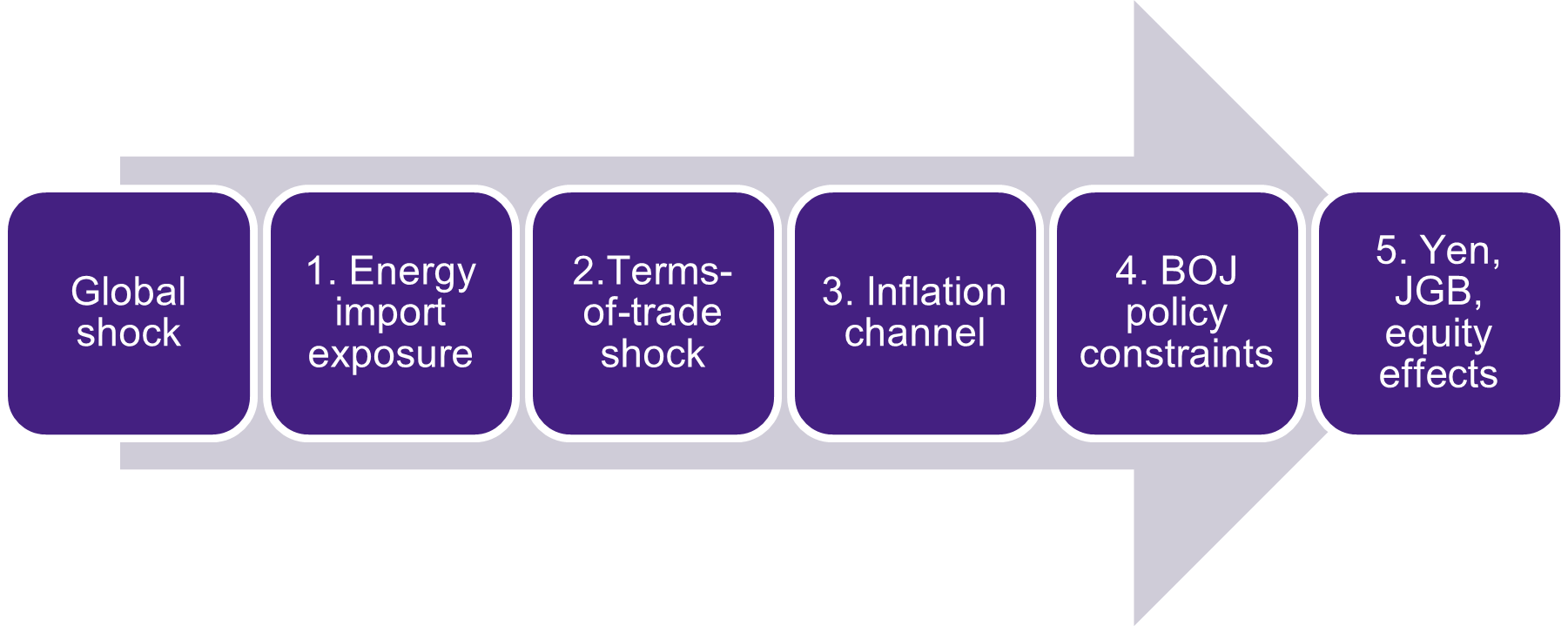
Source: Amova Asset Management (Iran conflict shock: risks may run deeper than markets assume)
Longer-term growth outlook positive, risks are inflationary
Longer-term, the central bank foresees growth as likely to rebound to above potential—around 0.5% by its own estimates— after temporarily returning to around (but not below, on median projections) potential growth in 2026. The outlook cites not only an eventual “improvement in terms of trade” but also structural “investment projects to adapt to changes in the trade structure and supply chains” and a rise in potential growth “due to advances in digitalisation and investment in human capital”, resulting in a “steadily” increasing capital stock.
Meanwhile, the BOJ increased its mentions of “upside risks” to prices in its April Outlook compared to the January edition. In addition, the central bank’s discussion of “Risks to Economic Activity and Prices” not only pertains to the situation in the Middle East but also highlights other factors such as AI demand, the pass-through of foreign exchange weakness and shifts in firms’ and households’ expectations. Taken together, these risks are also skewed to the inflationary upside. While the BOJ remains data-dependent, its Outlook increasingly underpins a narrative consistent with ongoing policy normalisation.
Ueda’s tone comparatively less hawkish
Assessing Ueda’s subsequent statement using five criteria, the governor’s statement appears less hawkish than the statement and Outlook report.
Optionality of June rate hike downgraded: Ueda opened the door to a rate hike so long as the economy does not have a major slowdown and upside price risks become more pronounced. However, he also continued to anchor on the realisation of the BOJ’s outlook, which may not be secured by June.
Inflation characterisation: Compared to the Outlook report, which significantly upgraded the mention of upside risks to inflation, the governor anchored on the outlook for “underlying inflation” to reach the BOJ’s 2% target between H2 FY 2026 and FY2027. Moreover, while Ueda acknowledged upside risks to inflation, he framed them as conditional and temporary rather than persistent.
Consistency with dissenters’ logic: Ueda partially acknowledged the need to take the three dissenting votes seriously, but then appeared somewhat dismissive, attributing the dissents to “the difficulty of judging” the current situation amid uncertainty, and declined to engage with Takata’s substantive argument regarding the achievement of the BOJ’s inflation target.
Balance of growth vs. inflation risks: Ueda did emphasise inflation risks over the risks to growth, and also voiced a commitment to avoid “falling behind the curve” on inflation.
Reaction function clarity: this may have been the greatest gap between the Outlook and Ueda’s statement. Despite the clear upgrade of inflation risks and the median core inflation forecast to above the BOJ’s target, Ueda provided no specific observable conditions to gauge the likelihood of the next hike, falling back on vague forward-looking language such as “risk materialisation” and “based on the economic situation”.
Conclusion: weak credibility means the ball is in markets’ court
In sum, the BOJ statement left the door open to a June rate hike, though Ueda’s press conference comments did not reinforce such expectations. Given the lack of clear guidance over future rate tightening, the BOJ appears to have left the question of credibility up to markets for now. In contrast to a decisive hike signal, this still leaves the door open for ongoing challenges to the BOJ’s resolve, and does not significantly reduce the potential amplification of yen weakness on Japan’s terms of trade, or rule out the potential for mutually dependent depreciation in JGBs and the yen.