


Global Equity Investment Philosophy
Our philosophy is centred on the search for “Future Quality” in a company. Future Quality companies are those that we believe will attain and sustain high returns on investment. ESG considerations are integral to Future Quality investing as good companies make for good investment. The four pillars we use to assess the Future Quality characteristics of an investment are:
Franchise - does the company have a sustainable competitive advantage?
Management- does the company make sound strategic and capital allocation decisions?
Balance Sheet - is growth appropriately financed?
Valuation - are the company’s prospects under-appreciated by the market?
We believe that investing in Future Quality companies will lead to outperformance over the full market cycle. Our strategy is based on fundamental, bottom-up research therefore sector and country allocations are a function of stock selection. The Global Equity strategy is a concentrated, high conviction portfolio with a high active share ratio.
Market outlook
The dramatic rotation away from defensives and quality in 2024–2025 is unlikely to continue at the same intensity. Relative valuations between quality and value have now converged toward historical norms, although signs of an imminent reversal back to quality are less apparent. With monetary policy stabilising and earnings growth expected to be more evenly distributed across sectors, we expect stock selection - not style bias - will drive returns in 2026.
The shift by investors from defensive, safer firms toward more cyclical exposures is also likely to run out of steam. Additionally, falling rate expectations, a macro environment consistent with slower (but not recessionary) growth, easing inflation pressures and more balanced earnings growth across sectors favour stock picking over style‑led allocation.
The AI spending wave is having significant implications for free cash flow and returns on invested capital among the major capex spenders, such as Meta Platforms Inc., which is therefore no longer a Future Quality candidate. In many cases, the leading players can and will continue to spend heavily on AI capex. As Microsoft Corporation CEO Satya Nadella has noted, the entire business proposition of today’s tech behemoths stands or falls on their ability to use AI as the “magnet” to attract new customers and retain existing ones. In other words, the product on offer is not an AI model but the full breadth of each company’s ecosystem. This existential imperative, combined with substantial cash reserves, suggests high AI spending will persist. This underpins our preference for the beneficiaries of that spending - where growing and sustained high cash‑flow returns are available - including Hitachi, Curtiss‑Wright Corporation, Amphenol Corporation and newly added ASM International.
Specifically regarding Alphabet, Inc., with the valuation now trading roughly 10 times higher and limited visibility on TPU sales - with Meta Platforms Inc. rumoured as a potential customer, one of the few large spenders that would make sense given they do not compete in cloud - the current risk‑reward appears skewed to the downside. A key takeaway from the Gemini 3 release was that scaling laws remain intact, implying that when NVIDIA based models are released, performance is likely to improve significantly and sentiment may shift. We also remain convinced that the economics underpinning Google Search are under meaningful pressure.
Our Future Quality approach remains laser‑focused on companies capable of consistently achieving and expanding high returns on invested capital. While the second half of 2025 has been a clear disappointment, the foundations for 2026 point to a far more supportive environment for Future Quality investing. Despite volatile conditions, we believe that our emphasis on identifying Future Quality companies with resilient competitive advantages, the ability to compound returns through cycles, and disciplined capital allocation remains the right path to long‑term capital compounding.
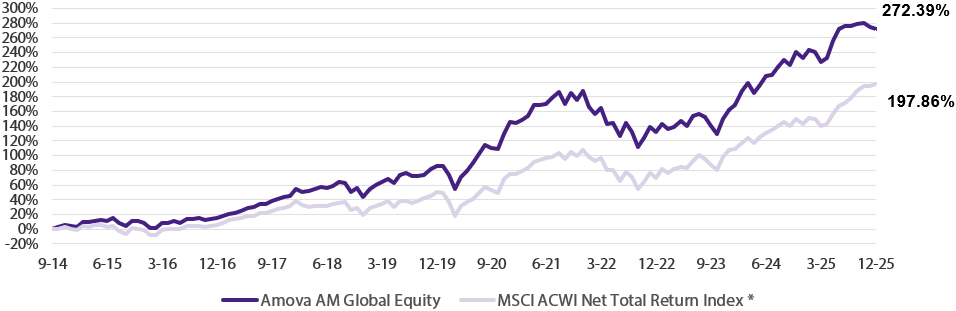
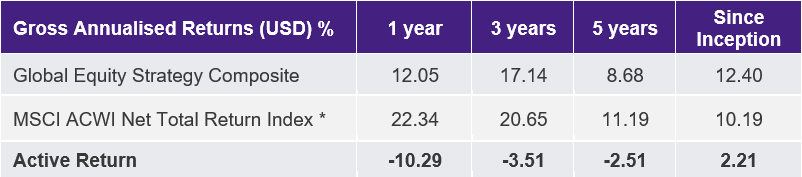
Past performance is not a guide to future returns. Any comparison to a reference index or benchmark may have material inherent limitations and therefore should not be relied upon.
Returns are based on Amova AM’s Global Equity Strategy Composite returns. The benchmark for this composite is the MSCI ACWI Net Total Return Index. The benchmark was the MSCI ACWI ex AU since inception of the composite to 31 March 2016. Returns are USD based and gross of management fees only. Returns in excess of one year are annualised, but those for the periods of less than one year are not annualised. Amova AM claims compliance with the Global Investment Performance Standards (GIPS®). GIPS® is a registered trademark of CFA Institute. CFA Institute does not endorse or promote this organization, nor does it warrant the accuracy or quality of the content contained herein. For more information on how to obtain the GIPS report please contact GIPS_inquiry@amova-am.com Source: Amova AM; Inception date: 01 Oct 2014.
Data as of 31 December 2025
Amova AM Global Equity: Capability profile and available vehicles (as at Dec 2025)
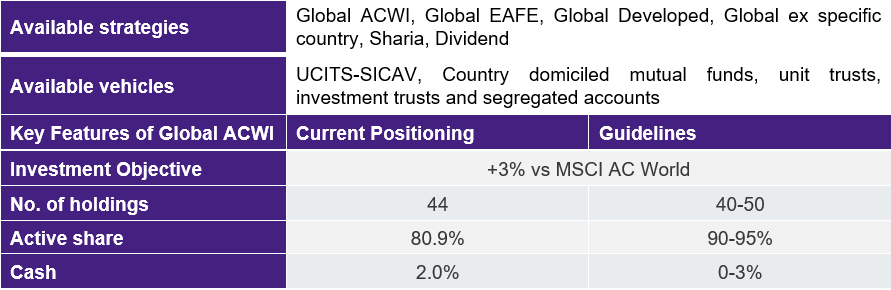
Target return is an expected level of return based on certain assumptions and/or simulations taking into account the strategy’s risk components. There can be no assurance that any stated investment objective, including target return, will be achieved and therefore should not be relied upon. Any comparison to a reference index or benchmark may have material inherent limitations and therefore should not be relied upon.
Past performance is not indicative of future performance. Amova AM Representative Global Equity account. Source: Amova AM, FactSet.
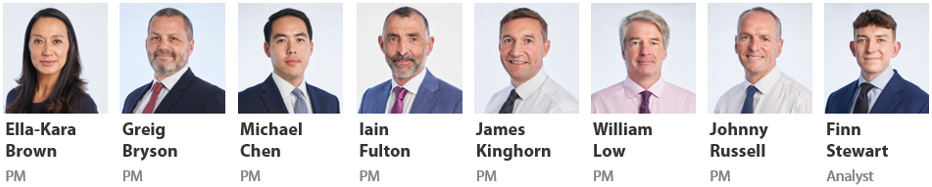
This Edinburgh based team provides solutions for clients seeking global exposure. Their unique approach, a combination of Experience, Future Quality and Execution, means they are continually “joining the dots” across geographies, sectors and companies, to find the opportunities that others simply don’t see.
There are four key areas that make our strategy different:
- a focus on Future Quality companies – a different and clear philosophy
- a distinctive team culture – a tight-knit team with a process built on openness and respect
- unique execution, including rigorous team challenge of every idea
- differentiated portfolios, with a strong track record in stock-picking and ESG integration
Future Quality companies
We believe that companies with superior long-term returns on investment will deliver better performance. We call these Future Quality companies, and it is only these companies that make it into client portfolios. We search for Future Quality through analysis and financial modelling of companies that we expect to deliver over the next five years, and beyond. This approach is supported by academic evidence that businesses with high and improving returns on invested capital provide superior compound performance over the long term. With this investment time horizon, the sustainability of returns is a crucial ingredient of our Future Quality approach. We have found that companies developing solutions to ESG issues and management teams providing value to all stakeholders are more likely to be successful at sustaining high returns on invested capital over the long-term.
Distinctive team structure and culture
We believe that our collective knowledge and experience are powerful tools for delivering investment performance. Since 2011, we have operated a team-based approach to uncovering Future Quality investment ideas and have fostered a strong group dynamic. Individually, each Portfolio Manager is an expert investor with a broad skillset and experience of many market cycles.
We work in a flat structure, where all our Portfolio Managers have a dual role that combines investment analysis and investment management responsibilities. With individual analytical coverage split along industry lines, each Portfolio Manager is a specialist in the stocks and sectors they cover.
We all actively challenge the ideas and analysis of colleagues throughout the investment process, in an open atmosphere of vigorous and constructive debate. Portfolio Analysts work alongside Portfolio Managers, typically researching thematic trends that could influence and uncover future investment opportunities.
We take collective responsibility for approving stocks for the portfolio, and therefore there is joint accountability for performance. As such, it is in everyone’s interest to ensure that the investment analysis is thorough and that no stone is left unturned in the search for Future Quality.
We believe that the broad experience of our Portfolio Managers and distinctive team-based approach that sees everyone contributing to the strategy, increases the probability of successfully uncovering Future Quality.
Unique execution
Our tight-knit team approach and flat structure enable us to execute in a transparent way, including a rigorous team challenge of every idea. By using our strict Future Quality standards, we can identify long-term winners from the broader universe, to narrow down a comprehensive watch list and around 100 deep dive researched ideas. This is within a unique framework of individual accountability for the underlying analysis and company research, combined with the collective challenging of assumptions at the team level. Our proprietary ranking tool creates a disciplined process to compare and rank attractive opportunities and ensures that at the portfolio construction phase, only our best-ranked ideas receive the most committed weights in client portfolios. We believe our culture is key, and the collective ownership of our research process brings the best portfolio outcomes for clients.
Differentiated portfolios
We deliver a high-conviction Global Equity strategy for clients that is not constrained by benchmarks. As such, Future Quality can be sourced from listed businesses across any geography or sector. And, in a world awash with investment prospects, our disciplined, accountable and transparent process helps us to focus solely on building portfolios from companies that best meet our specific Future Quality criteria.
In terms of balancing risk and reward, our track record shows that we consistently deliver attractive returns on a lower risk-adjusted basis compared with peers and the global reference benchmark. The high active share and concentrated number of holdings help ensure that our Future Quality stock-selection process delivers differentiated portfolios.
Risks
Investing involves the risk of loss of capital due to factors such as overall market fluctuations, economic and political conditions, and changes in the value of individual securities. There is no guarantee that investment objectives will be achieved. The following non-exhaustive risk factors may affect investments in the strategy or strategies described in this marketing communication. Actual risks will vary by strategy, and not every risk listed will be applicable to each strategy. However, investors should consider all these potential risk aspects when evaluating the strategy.
Currency risk - this exists when the strategy invests in assets denominated in a different currency. A devaluation of the asset's currency relative to the currency of the Sub-Fund will lead to a reduction in the value of the strategy.
Equity Risk - the risks associated with investments in equities may be higher, because the investment performance of equity securities depends on factors which are difficult to predict. Such factors include the possibility of sudden or prolonged market declines and risks associated with individual companies. The fundamental risk associated with any equity portfolio is the risk that the value of the investments it holds might decrease. Equity security values may fluctuate in response to the activities of an individual company or in response to the general market and/or economic conditions.
Liquidity risk - investments that could have a lower level of liquidity due to (extreme) market conditions or issuer-specific factors and or large redemptions of shareholders. Liquidity risk is the risk that a position in the portfolio cannot be sold, liquidated or closed at limited cost in an adequately short time frame as required to meet liabilities of the Strategy.
Operational risk - due to issues such as natural disasters, technical problems and fraud.
Credit Risk - is the possibility that a bond issuer will fail to pay interest and principal in a timely manner.
Emerging markets risk –emerging markets may be exposed to political, fiscal and institutional instability that creates risks associated dealing, settlement, accounting, ownership, custody as well as liquidity (including the risk of internal or external embargos on the sale or acquisition of currencies and securities).
Hedging risk –hedging is performed at a cost, and the returns of the forward or swap currency contracts may not perfectly offset the actual fluctuations being hedged, which may increase the volatility of the strategy. If the counterparty of derivative transaction used within the hedging process defaults and is unable to meet its contractual obligations, the value of the derivatives dealt with that counterparty may become nil.
Debt default risk - high yield debt instruments are materially exposed to the risk that their issuer may not be able to meet its interest payment or principal reimbursement obligations.
Deposits default risk - deposits and money market instruments are exposed to the risk that their issuer may not be able to meet its interest payment or principal reimbursement obligations.
Derivative leverage risk - the derivatives used within the strategy may create leverage that increases short-term volatility and exposes the strategy to larger losses.
Derivatives counterparty risk - a counterparty involved in a derivative transaction with the portfolio, may fail to meet its obligations which could cause losses.
Sustainability risk – The risk arising from any environmental, social or governance events or conditions that, were they to occur, could cause material negative impact on the value of the investment.
Specific sustainability risk can vary for each product and asset class, and include but are not limited to: Transition Risk, Physical Risk, Social Risk and Governance Risk.