


Shift in rice policy and CPI
Sanae Takaichi formed her administration as Japan’s new prime minister on 21 October 2025. Takaichi is perceived as supporting a high-pressure economy, in which fiscal and monetary policy are used proactively to boost economic growth. While attention tends to focus on the scale of the new administration’s economic policies and its relationship with the Bank of Japan (BOJ), we believe that the administration’s shift on rice policy is also noteworthy .
The first question to be considered is why rice is important to the consumer price index (CPI). Although rice itself accounts for only about 0.6% of the overall CPI, if we factor in items that contain rice—such as boxed lunches, frozen rice and set meals at restaurants—its estimated CPI weighting increases significantly to around 3.5%. It has also been pointed out that rice has an indirect impact on price increases for processed foods in which it is not directly used. According to Teikoku Databank, over 20,000 items experienced price hikes in 2025, with an average increase of 15%. The strongest factor driving these increases was higher raw material costs, and many price hikes were likely implemented to capitalise on the surge in rice prices. As rice is Japan’s staple food, a surge in its price could influence Japanese consumers’ inflation expectations and potentially affect underlying price trends. In addition, BOJ Policy Board member Junko Koeda observed in late November that soaring rice prices could impact other pricing behaviour by pushing up consumers’ inflation expectations.
The next question to consider is how the change in Japan’s prime minister has caused a shift in the country’s rice policy. Having declared its intention to lower rice prices, the previous administration under Shigeru Ishiba released stockpiled rice and aimed to increase rice production by reversing Japan’s long-standing policy of reducing acreage under cultivation. However, Japan has changed course on rice under the new administration. At his first press conference as the country’s new Minister of Agriculture, Forestry and Fisheries on 22 October, Norikazu Suzuki stressed that the government would not provide any commitments on rice prices. He subsequently commented that the basic principle for rice would be “production aligned with demand” and signalled the government’s intention to reduce the volume of rice produced for staple use in the 2026 fiscal year compared with the previous year. This marked a return to Japan’s past policy of reducing acreage for rice cultivation. Suzuki has also proposed the distribution of “rice vouchers” to support consumers struggling with soaring prices. This approach of cutting rice production while propping up demand with rice vouchers seems likely to heighten the risk of persistently high rice prices.
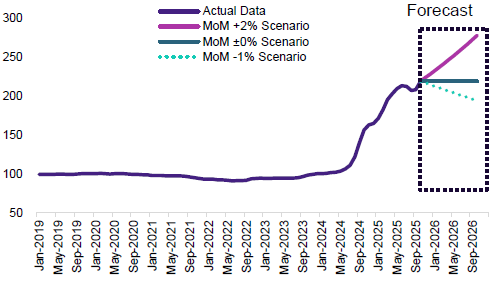
Economists had previously been projecting a scenario of gradually declining rice prices, partly in view of the previous administration’s policies. It is true that the rice component of Japan’s CPI decreased in July and August of 2025 after peaking in June.
However, rice price increases picked up pace again from September, when relatively expensive new rice entered the market, with prices surging by 5% month-on-month in October. Given that the recent jump in rice prices likely reflects the impact of the new crop, we feel that prices are unlikely to grow at the same high pace. Nevertheless, the new administration’s rice policy makes an average increase of around 2% entirely conceivable (Chart 1). It therefore seems reasonable to anticipate a rice price outlook in which the change in prices ranges from flat growth to an increase of approximately 2%. Many economists have projected that the year-on-year change in the CPI (excluding fresh food) would fall below 2% in the case of a gradual decline in rice prices. However, should rice prices remain flat or rise, the figure is more likely to be higher than expected.
Chart 1: Japan CPI rice (level)
Source: Ministry of Internal Affairs and Communications, Bloomberg
Economic measures and the CPI
The Takaichi administration’s economic policies could also be a factor in pushing Japan’s CPI higher. On 21 November, the government announced an economic stimulus package totalling Japanese yen (JPY) 21.3 trillion (JPY 17.7 trillion in outlays from the general account and JPY 2.7 trillion in tax cuts). Measures to address living costs and inflation account for JPY 11.7 trillion of the total package, enhancements to Japan’s defence capabilities account for JPY 1.7 trillion, and investments in crisis management account for JPY 7.2 trillion, with the living costs and inflation measures making up the bulk of the total amount. Some analysis suggests that the package could boost Japan’s fiscal year 2026 GDP by around 0.5%. The measures to address living costs and inflation include subsidies for winter electricity and gas bills, which will push down CPI until early spring 2026. However, as these subsidies will only apply in the winter, some of the CPI decline is expected to reverse once spring begins. At the same time, the living costs and inflation part of the package includes measures intended to boost demand, such as funding for local governments and payments to households with children. The crisis management investment portion encompasses support for capital expenditure in areas like artificial intelligence, semiconductors, shipbuilding and national resilience.
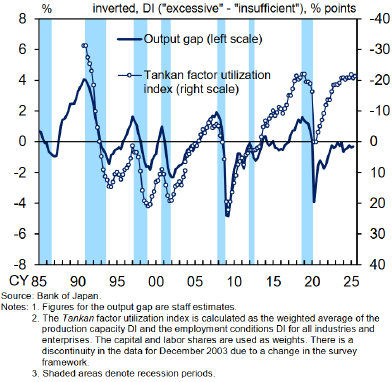
Estimates by the BOJ indicate that Japan’s output is near zero per cent (Chart 2). Conversely, the weighted average of the employment conditions DI and the production capacity DI in the BOJ’s Tankan survey was significantly positive. Given Japan’s labour shortage, this suggests that supply constraints in the real economy are more severe than the output gap indicates. Implementing stimulus measures in such tight supply conditions is likely to intensify upside risks to inflation.
Chart 2: Japan’s output gap
Terminal interest rates
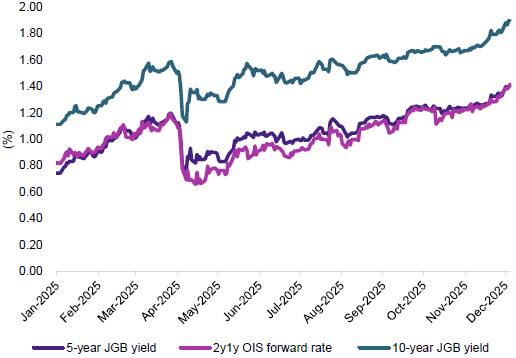
The terminal interest rate currently priced in by the market, as reflected in the 2y1y OIS forward rate (one-year OIS forward rate starting in two years), has risen to about 1.5%.The BOJ has estimated the nominal neutral interest rate to be in a range of approximately 1% to 2.5%. As it has also emphasised the challenges involved in pinpointing the neutral rate, in its actual implementation of policy, the BOJ is likely to hike rates while monitoring their impact on markets and the economy and seeking to identify the equilibrium level for rates. Given the aforementioned complex upside risks to the CPI, the BOJ’s terminal rate could rise above current market expectations.
An examination of the 5-year JGB yield and the 2y1y OIS forward rate reveals that the two have tended to move in close correlation with each other (Chart 3). As market expectations for the terminal rate rise, rates in the medium-term JGB zone may increase. Furthermore, the 10-year yield has generally moved in parallel with the 5-year yield, suggesting that the long-term yield may also move higher in line with the increase in terminal rate expectations.
Chart 3: 2y1y OIS forward rate and 5-year JGB yield
Source: Bloomberg
Fiscal sustainability
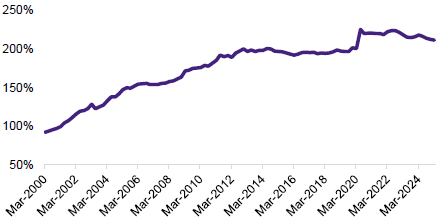
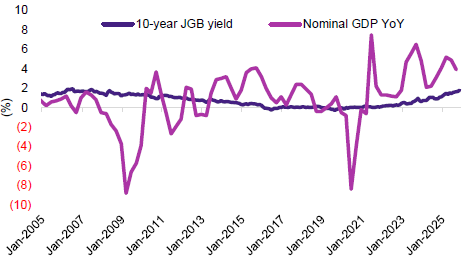
Japan’s government debt-to-GDP ratio, which is one of the key indicators for assessing debt sustainability, has fallen, partly as a result of higher-than-expected tax revenues driven by inflation after the pandemic (Chart 4). Furthermore, the current 10-year yield remains below the nominal GDP growth rate, meaning that Japan’s fiscal position meets the Domar condition. We therefore believe that the debt-to-GDP ratio is unlikely to diverge significantly beyond its post-pandemic peak over the next few years (Chart 5).
That said, Japan’s debt-to-GDP ratio remains high. An increase in defence spending in response to US demands for its allies to spend 3.5% of their GDP on defence could be detrimental to Japan’s fiscal health in the future. Furthermore, with yields expected to rise going forward, the spread between yields and the rate of GDP growth is expected to narrow. This heightens the risk of an increase in interest payments creating a fiscal burden. While trends in super-long JGB yields and the yield curve suggest that Japan’s fiscal concerns have receded for the time being, they warrant continued attention as a theme over the medium to long run.
Chart 4: Japan gross government debt to GDP ratio
Source: Cabinet Office, Ministry of Finance (MOF), Bloomberg
Chart 5: Japan nominal GDP
Source: Cabinet Office, Bloomberg
Issuance plan and supply/demand for super-long JGBs
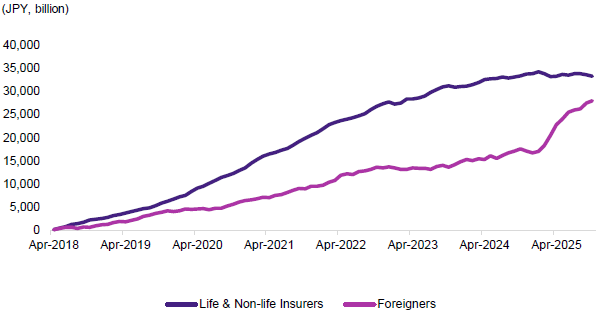
In 2025, a rise in super-long JGB yields attracted attention. This appeared to reflect a drop in demand for super-long JGBs as life insurers paused purchases made for regulatory compliance purposes (Chart 6). Overseas investors stepped in and purchased super-long JGBs in place of the life insurers. Although the holding ratio of overseas investors remains low, it is attracting attention as a factor that could increase volatility compared with levels seen in the past.
The MOF has been reducing issuance in response to declining demand and has progressively cut its issuance of super-long JGBs since April 2025. In its initial draft plan for fiscal year 2025, the ministry reduced its issuance of 40-year bonds (issued every other month) by a monthly amount of JPY 0.2 trillion and cut its issuance of 30-year bonds (issued monthly) by JPY 0.1 trillion per month. In June, the ministry made the unusual move of altering its issuance plan mid-year, further reducing issuance of 40-year bonds (issued every other month) by an additional monthly amount of JPY 0.1 trillion, 30-year bonds (issued monthly) by an additional JPY 0.1 trillion per month, and 20-year bonds (issued monthly) by JPY 0.2 trillion per month. In September, it reduced the monthly amount for super-long JGB auctions (held every other month) in liquidity enhancement auctions by JPY 0.1 trillion.
A meeting summary released after the MOF’s late-November meeting with primary dealers (known as the Meeting of JGB Market Special Participants) indicated that many participants had commented that it would be appropriate to reduce super-long JGB issuance, and that participants had responded positively to the possibility of half-yearly reviews of the JGB issuance plan. This seems to raise the likelihood of the ministry continuing to proactively adjust its issuance plan in response to trends in demand. It also points to the possibility of further reductions in super-long JGB issuance. Steady reductions in the MOF’s super-long JGB issuance can be expected to improve supply and demand conditions in this JGB segment for fiscal year 2026 compared with fiscal year 2025.
Chart 6: Net purchases of super-long JGBs (over 10-years) by investor type
Source: Japan Securities Dealers Association
Summary and market outlook
The shift in rice policy under the Takaichi administration has raised the probability that Japan will experience persistently high rice prices. Considering the impact the cost of rice has on consumer inflation expectations and other pricing decisions, this has also made it more likely that CPI will exceed market forecasts. The Japanese economy faces severe supply constraints, including labour shortages. Under these conditions, increases in demand resulting from economic stimulus measures led by the Takaichi administration could heighten upside inflation risks. The BOJ is expected to continue raising interest rates while monitoring the impact of rates on the real economy, and the aforementioned upside inflation risks are likely to put upward pressure on the terminal rate of the hikes priced in by the market. Given that Japan’s fiscal position currently satisfies the Domar condition, it is unlikely that the country’s debt-to-GDP ratio will diverge beyond its post-pandemic peak over the next few years. With the MOF steadily reducing issuance of super-long JGBs, supply/demand conditions in this maturity band are expected to improve in 2026 compared with 2025.
Given the points noted above, we feel that medium-to-long-term JGB yields are likely to continue climbing. This is mainly in view of potential increases in the terminal rate coupled with the possibility of supply/demand conditions easing in line with a rise in issuance and quantitative tightening by the BOJ. As the MOF’s measures are expected to improve supply/demand conditions for super-long JGBs, that zone has the potential to outperform the medium-to-long-term JGB segment over the long run. However, it should also be noted that while fiscal concerns already appear to have been factored into the market to a certain extent, concerns over possible fiscal expansion under the Takaichi administration, including increased defence spending, are likely to persist for the time being. This may make investors less proactive in purchasing super-long JGBs.