


The Bank of Japan (BOJ) board voted unanimously to hike interest rates by 25 basis points (bps) to 0.75%—a 30-year high—at the conclusion of its latest policy meeting on 19 December. The move was widely expected and had been priced into Overnight Indexed Swap (OIS) rates before the decision. The unanimous vote follows a 7-2 split when the BOJ kept rates on hold in October, signalling that policy views among board members have become more aligned.
That said, two of the BOJ’s more hawkish members (Naoki Tamura and Hajime Takata) are reported to have expressed dissenting views on the outlook, maintaining that the level of inflation had either already met or was likelier to meet the BOJ’s target earlier than the BOJ baseline. This is indicative of hawkish discomfort with cautious phrasing on Japan’s inflation prospects. Although the consensus vote reduces policy uncertainty, the bias remains tilted toward hikes, with potential upside inflation and growth surprises leaving the door open to earlier normalization of rates than currently projected.
The immediate reaction in markets, however, was to bring the yen moderately lower after the announcement given the caution, rather than outright hawkishness, indicated by the BOJ’s forward communication, which signals the pace of hikes. Following BOJ Governor Kazuo Ueda’s post-meeting press conference, in which he implicitly committed to gradualism by emphasising the need to monitor the economy’s response to hikes to date, the yen’s decline intensified.
In justifying the rate increase, the BOJ is effectively communicating that the “virtuous circle” of “moderate” wage and price rises is resilient, and that uncertainty surrounding external risks, though not eliminated, has decreased.
The policy statement explicitly states that real interest rates remain “significantly low” and that they are “expected to remain significantly negative” after the hike. This conveys that, even at 0.75%, the policy rate remains accommodative. This is consistent with the BOJ’s signalling to date, with central bank estimates of “neutral” real rates ranging from -1 to 0.5% (see graph demonstrating various models of neutral short-term real rates (r*) from a BOJ research paper in Chart 1, below); as a back-of-the-envelope estimate, adding back in the 2% inflation target results in a rough reference range with nominal rates at 1–2.5%.
Regarding inflation, the BOJ points out that it is becoming more likely that underlying CPI inflation will be viewed as “consistent with the price stability target of 2%” in the second half of the fiscal 2026 projection period communicated in the October 2025 outlook report. However, it stops short of indicating that its target has been achieved.
The BOJ’s forward-looking language has indicated that accommodative financial conditions are expected to “firmly support economic activity”; however, the bank has stopped short of committing to accelerating the pace at which accommodative policy is wound down. Although directionally clear in its intention to hike rates, the BOJ is still reliant on future “improvement in economic activity and prices” consistent with the October 2025 outlook report to determine the timing of future increases in policy interest rates.
Given some expectations of future fiscal stimulus by the market, the ongoing bear-steepening bias may remain intact as bond markets price in future risk, even in the absence of an apparent acceleration of inflation in the near term. Meanwhile, although BOJ Governor Ueda signalled that the BOJ retains the option to conduct operations in the face of “exceptional” or disorderly moves, he also emphasised that the substantial bond holdings on the BOJ’s balance sheet still exert downward pressure on yields, implying a reluctance to intervene (via operations in the bond or money markets) in anything but extraordinary circumstances.
Chart 1: Bank of Japan estimates of r* (neutral short-term real rates)

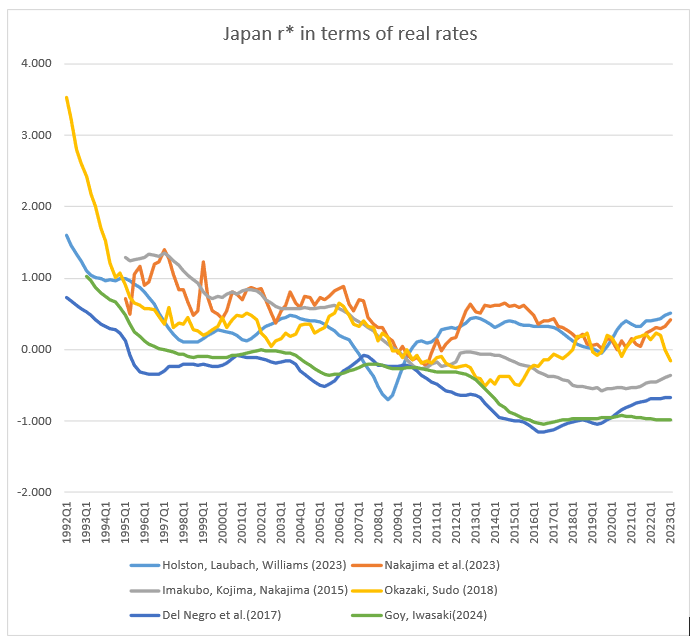
Source: Bank of Japan