


Fed’s decision as expected, most of the news comes from Powell’s statements
Most of the news from the Federal Open Market Committee (FOMC)’s well-signalled monetary policy decision on 7 November came at Federal Reserve (Fed) Chair Jerome Powell’s press conference, which was held after the announcement of its unanimous vote to cut interest rates by 25 basis points (bps). On the surface, the FOMC statement was not a controversial one as the rate cut was all but fully priced in before the November meeting with only modest changes having been made to the policy statement.
Change in language: with forward guidance omitted, risks are now two-way
One of the sparse but significant changes in the FOMC’s policy statement was the omission of two items. The first omission was the phrase stating that the Committee was “gaining confidence” in inflation moving sustainably toward its 2% target. The second omission was the “progress on inflation and the balance of risks”. When asked about the changes, Powell clarified that the omission of these two phrases was a removal of forward guidance, which the Fed deemed no longer necessary as it had already embarked upon its rate cut regime. Additionally, according to him the pace of adjustment and “final destination” of neutral interest rates are both yet to be determined.
In addition to omitting forward guidance, the Fed may also slow its easing pace
Powell remained sanguine about both inflation and growth. However, he emphasised both upside and downside risks—of deterioration in US employment or inflation failing to continue trending lower toward 2%—as reasons for the Fed to be deliberate about continuing to adjust what it still judges to be restrictive monetary policy, with no preset pace or fixed numerical target, leaving terminal rates still indeterminate (currently estimated as between 2-2.5% per the Fed’s September Summary of Economic Projections). Importantly, however, when asked later in the press conference whether the market might rule out rate hikes over the coming year, he emphasised that uncertainty was such that it remains impossible to rule out any scenario at such a “long” horizon.
All this suggests that policy has become more uncertain. Although there is no reason to assume further rate cuts are off the table in 2025 (or for December 2024 for that matter), any substantial deviation of either inflation or the economy (and particularly employment) from current situations could quickly shift monetary policy trajectory. This adds a little more uncertainty to the longer end of the yield curve.
Election impact? No comment, but watch inflation expectations
Powell was asked repeatedly over the course of the press conference about the impact of the still fresh US election result on the FOMC’s decision-making. He indicated that the monetary policy impact of elections remains zero for now, simply because the fiscal policies of the incoming administration are not yet fully specified and therefore impossible to model. Therefore, until the new administration’s policies are better specified, monetary policy is not expected to respond directly to speculation regarding Trump’s fiscal initiatives. It is also possible that the Fed is acting on what it knows thus far, which is that the economy, while solid, has shown cooler price and employment trends. The Fed may be seizing the opportunity to move policy to a less restrictive stance while it can, even if it has to adjust to new information (such as fiscal expansion amid an already over-extended fiscal position) once it arrives.
However, things may be different if expectations of fiscal easing under Trump prove to be proximate drivers of any spike in inflation expectations. The Fed will likely continue to monitor inflation expectations, regardless of whether they arise due to anticipated fiscal policy loosening or other reasons.
Regarding inflation expectations, keep an eye on the 5-year/5-year BEI
For now, despite the move higher in the longer end of the US yield curve, Powell indicated that the Fed sees no particular aberration in interest rates or inflation expectations. By the same token, it is possible that inflationary tail risk scenarios are not fully priced in by the market. Lately, the indicator that has been attracting Powell’s attention is the 5-year/5-year breakeven inflation rate (BEI), which, for much of the time since 2020, has remained slightly above the 2% handle but within a range below 2.5% (see Chart 1). In Powell’s estimation, this is “consistent” with the Fed’s current inflation target. It is advisable to keep an eye on this indicator for signals of resurgent long-term inflation expectations. Powell indicated that the Fed is unlikely to tolerate inflation expectations anchoring any higher, and if they did, the Fed may interrupt or end its rate cut cycle, having arrived at some approximation of “neutral” rates.
Chart 1: US 5-year/5-year BEI
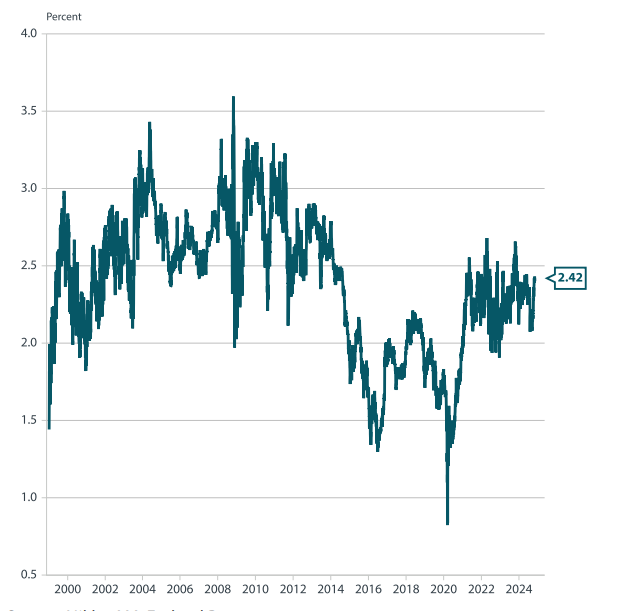
Source: Nikko AM, Federal Reserve
The “destination” of neutral rates typically depends on long-term inflation expectations plus an approximation of “natural” interest rates, which, if in line with recent trend in real interest rates, remains quite low (well below 2%). Should long-term inflation expectations anchor higher, this is expected to adjust the “destination” (terminal rates) higher as well.
However, it is worth noting that long-term inflation expectations typically take some time to solidify, and this may be reflected in the two-way action in the 5-year/5-year BEI. As such, expect the Fed to pay greater attention to adjustments in the trend rather than short-term moves.
Are we there yet? Focus on employment and inflation (especially core services)
Given the Fed’s removal of forward guidance and its dependence on data, markets will be asking before every meeting whether economic data justify the Fed continuing to cut rates or remaining on hold. Regarding the series to watch, Powell not only mentioned jobs and unemployment (which were recently skewed by storms as well as strikes in the US), but also national income and product accounts (NIPA) data that showed healthier household savings than prior to revisions. Also, by noting that current core PCE remains higher than desired at a 2.7% year-on-year rate (though 3- and 6-month measures are not as high) the FOMC anticipates currently elevated service price inflation (e.g. the adjustment of rents) to subside by January 2025 as basis effects from late 2023 are priced out. Conversely, if this does not happen, the likelihood of a pause increases. There are two more inflation data releases (and one employment data release) before the next FOMC meeting, and these will be important indicators for whether the Fed cuts rates again in December.
The end of Powell’s term in 2026 may be pivotal for the Fed’s independence
In our recent insight, After Trump's win, fiscal policy and inflation risks in focus, we mentioned that fiscal policy remains one longer-term risk for interest rates and inflation. It may eventually be necessary to add to this the president-elect’s stance toward Fed independence. When Powell was asked by journalists whether it would be possible for the president-elect to compel him or other FOMC governors to resign or accept demotion prior to the end of their terms, the Fed chair replied that such actions would not be possible under the law, and moreover, that he would not accept any request for his resignation. Powell’s term ends in 2026 and markets will be watchful of whether any new appointment at that time may bring the prospect of a less independent Fed, which could undermine its inflation-fighting credentials (recalling that central banks typically face asymmetrical risks biased toward the inflationary).